Showing posts with label church. Show all posts

Wednesday, December 11, 2013

St Martin in the Fields Church Virtual Tour


St Martin in the Fields 360 Panorama Image

St Martin in the Fields is a famous church in London, found on the north east corner of Trafalgar Square. The current church was designed by James Gibbs in the early 18th century. At the time it was built, the church stood in a field part way between the City of Westminster and the City of London. In 2006 a Roman grave was found on the site, indicating that the site had been used as a religious place of worship for hundreds of years.

This interactive, 360 panorama shows the interior of the church. It was taken by Peter Watts in September 2013.


Today, St Martin in the Fields is a popular concert venue, with classical concerts and organ recitals often being held in the church itself. Beneath the church, in the Crypt Cafe, jazz concerts are often held. Being right next to Trafalgar Square, the church is also a popular tourist attraction. It is also the parish church of Buckingham Palace, Number 10 (Downing Street) and the Admiralty.

Monday, November 27, 2006

Westminster Abbey - London

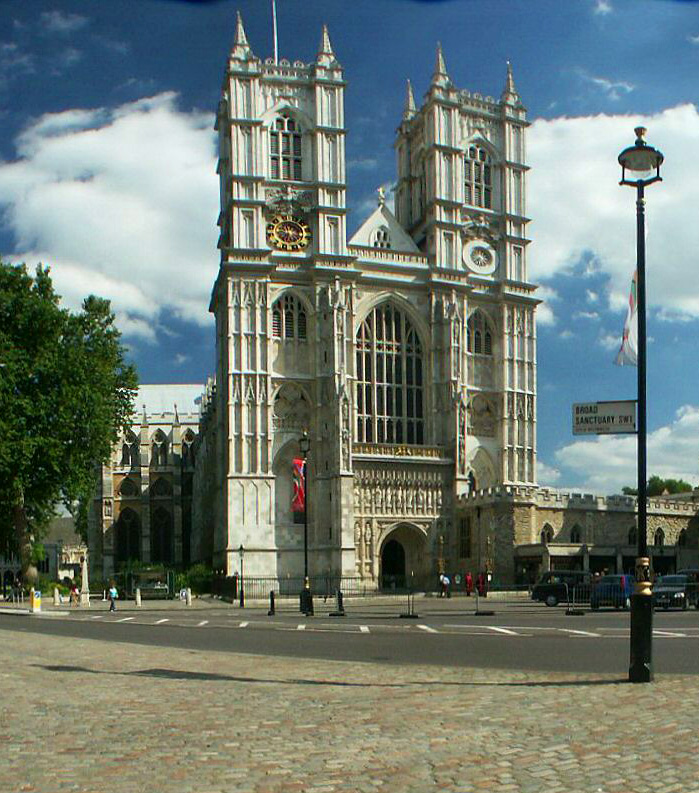
Front of Westminster Abbey in London

This photo of Westminster Abbey in London is part of one of the panoramic images found on the PanoramicEarth.com Tour of London. There are over 100 images taken from around London linked to an interactive map.

Plan your visit to London by taking advantage of these London Hotel Specials or Thomson City Breaks. Get the most of London with these London Guide Books

Westminster Abbey is another very popular attraction in London. The Abbey is very close to the Houses of Parliament (Palace of Westminster), Big Ben and Westminster Cathedral (a Catholic Cathedral) and Westminster Central Hall (Methodist place of worship). Westminster Abbey is both a huge construction with a similarly long history. Unfortunately for those visiting, photography and filming is not allowed within the Abbey or the adjoining St. Margaret’s Church. Equally, Westminster Abbey does not participate in London Pass offers.

The whole area owes it’s name to the Abbey, as it was called the West Minster to distinguish it from St Paul’s (East Minster) in the City of London. This name then became associated with the area around the Abbey, which is now known as Westminster.

The history of Westminster Abbey may date back to 616 when a shrine is supposed to have been built on what was then known as Thorn Island. By the mid 900s a community of Benedictine monks was established here by Saint Dunstan with the help of King Edgar. In the 11C Edward the Confessor built a stone abbey here, and it was consecrated in 1065 just before he died and was buried under the high altar. Harold was then crowned in the abbey, the (last) Anglo Saxon king of Britain, being killed by William in 1066. The only picture of the Abbey from this Norman period is that shown in the Bayeux Tapestry.

The next building phase was started by Henry III around 1245 and took some 300 years to complete, providing the highest Gothic Nave in England, and a much elaborated shrine to Edward the Confessor. Henry VIII assumed control of Westminster Abbey in 1539, granting it Cathedral status and sparing it from dissolution or destruction.

Thereafter the Abbey was caught in a religious game of ping pong, with the various monarchs changing the status of the building depending on whether they were Royalist Protestant, Catholic or non-Royalist Protestant. Thus made a Cathedral by Henry III, the Abbey’s control reverted to Benedictine Monks under Queen Mary (Catholic), only to be ejected again on the ascendancy of Queen Elizabeth I to the throne in 1559. It was threatened with destruction by Puritans wanting to destroy religious icons, but protected by the Sate under Oliver Cromwell, who was buried there in 1658 (only to be disinterred and hanged nearby and then beheaded in 1661 when the Royalists regained power).

Thankfully, Westminster Abbey survived all these upheavals and remains to play an important part in the British heritage. The Abbey has been the location of almost every coronation since 1065, with the new monarch being crowned seated on King Edward’s Chair, which dates from 1296. (The chair also contained the Stone of Scone, upon which Scotish Monarch had been seated until it’s capture by the English in 1297, and finally returned to Scotland in 1996.). Westminster Abbey is also the location of Royal Funerals, and a great number of Kings and Queens of England lie buried within.

There is so much that could be written about the various tombs, statues and other artifacts within Westminster Abbey, but there is not sufficient space here.

The nearest tube stations to Westminster Abbey include Westminster and Victoria.

Over 200 Destinations with HotelConnect.

The full panoramic image taken of Westminster Abbey can be found on the London tour by PanoramicEarth.com. An enlargement of this photo can be found on Flickr.

For more articles on London see the London Index or select one of the labels at the bottom.

Friday, October 27, 2006

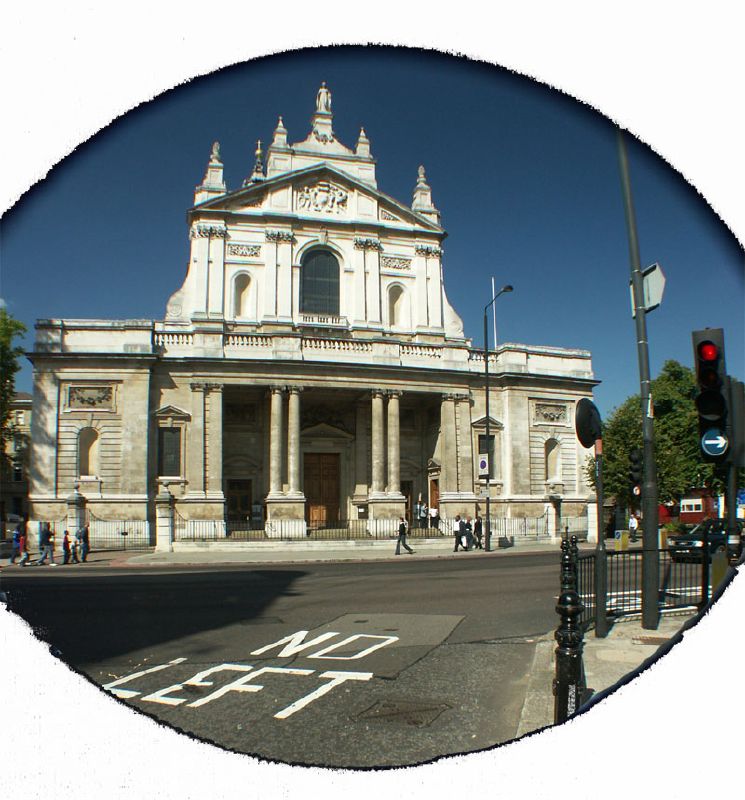
Brompton Oratory - London

Brompton Oratory in London

This photo from the Brompton Oratory in London is part of one of the panoramic images found on the PanoramicEarth.com Tour of London. There are over 100 images taken from around London linked to an interactive map.

Plan your visit to London by taking advantage of these London Hotel Specials or Thomson City Breaks.

The Brompton Oratory is found on the Brompton Road in London. This is a very busy road with runs from Knightsbridge to this point before changing name while continuing past Harrods and then past the Victoria and Albert (V&A) and the Natural History Museum. It is actually quite difficult to find a good place to take a panoramic picture of the area around the Brompton Oratory for the very simple reason that standing in the middle of 4 lanes of traffic is not conducive to a long life.

The real name of the Brompton Oratory is the Church of the Immaculate Hear of Mary, it is the second largest Roman Catholic church in London after Westminster Cathedral. The Oratory was consecrated in 1884 and is about 200 ft high at the tallest point. It is built in Italian Baroque style, as an exact copy of the Il Gesu church in Rome.

The high altar stands in a 70 foot deep alcove whilst in the sanctuary stand two seven-branched candlesticks, copies of the menorah used in the Temple in Jerusalem (the menorah is one of the oldest symbols of the Jews, said to symbolize the burning bush seen by Moses on Mount Sinai) and which are depicted by on the Arch of Titus in Rome.

The lavishly gilded nave and dome mosaics are the work of Comandatore Formilli (1927-32). Though the dome is striking, it is the pulpit that catches the eye first; this baroque wonder seems alive with flowing lines and extravagant decoration quite seldom seen in British churches. The 1930’s wooden pulpit stands prominently in the nave, an intricate structure also in Baroque style.

The interior contains some artifacts that are older than the church itself. The fitted with marble columns, a vaulted domes, various mosaics and other pieces of art. Located in the nave are the 12 apostles, carved for the Siena Cathedral in 1680 by Mazzuoli. The Lady Chapel also contains a late 17C altar.

Next to, but set back from Brompton road form, the Brompton Oratory stands Holy Trinity Brompton, an Anglican church, the building of which is much overshadowed by the Catholic structure. Just down the road are Harrods and a number of museums including the V&A and Science Museum. The nearest tube station is Knightsbridge.

Over 200 Destinations with HotelConnect

The full panoramic image of the Brompton Oratory can be found on the London tour by PanoramicEarth.com. An enlargement of this photo can be found on Flickr.

For more articles on London see the London Index or select one of the labels at the bottom.

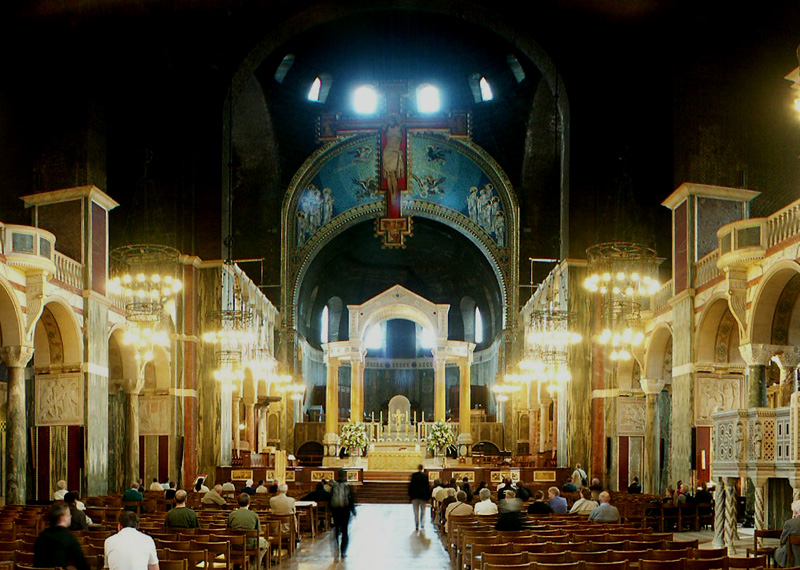
Westminster Cathedral - London

Interior Westminster Cathedral, London, showing the nave and high altar.

This photo from inside Westminster Cathedral in London is part of one of the panoramic images found on the PanoramicEarth.com Tour of London. There are over 100 images taken from around London linked to an interactive map.

Plan your visit to London by taking advantage of these London Hotel Specials or Thomson City Breaks.

Westminster Cathedral is tucked away in a piazza of Victoria Street, about half way between Victoria Station and Parliament Square. Previously the site was occupied by the Tothill Fields Prison (formerly called Middlesex (Westminster) House of Correction), a prison for boys. This was brought in 1884 by Cardinal Manning and on it now stands the current Cethedral. The foundation stone was laid in 1895 and the bulk of the building was completed by 1903.

It is quite an extraordinary building in London, with the tall tower, domes and balconies all built in the Byzantine style of the Easter Roman churches rather than the Gothic styles Europe was familiar with (or the Baroque style of the Brompton Oratory in Knightsbridge). However, the uniqueness of Westminster Cathedral does not stop here. The vast interior is an ongoing project and not yet considered complete.

To date there are over 126 types of marble from 26 countries on 5 continents used to decorate the interior. Almost everywhere you look yet another colour of stone catches the eye, from the large pillars in the nave to fine patterns on St. Patrick’s chapel (where a lot of the stone used is Irish) and St. Andrew’s chapel. The work is going on and in 1995 more marbles were installed within the Nave. The high altar is made of twelve tons of Cornish granite and above it is a canopy of white Carrara inlaid with coloured marbles and resting on eight columns of yellow Verona. And that is just a taster.

Some of the interior is clearly symbolic. The two red pillars inside the entrance of Westminster Cathedral represent the blood of Jesus shed on the cross, while the sea animals in the floor of St. Andrews chapel represent his former life as a fisherman before becoming a follower of Jesus.

From there it is possible to move on to the mosaics that decorate some of the interior. These are by no means complete as only 7 of the 12 chapels have yet been decorated (as of 2006). However, an impressive amount has already been installed, the blue arch over the sanctuary has over 1,000,000 pieces to make up the mosaic, while the mosaic found in the Lady chapel contains some 3 million pieces!

Westminster Cathedral really is a hidden treasure, not as popular as nearby Westminster Abbey or St Pauls Cathedral in the City, but well worth a visit. The advantage of this attraction is that, unlike the others, no one is going to demand money off you before you step inside. You can pay, if you wish, to ascend the tower of Westminster Cathedral and get a glimpse of the skyline of London, where you can see all the way over Westminster and as far out as the arches of the new Wembley stadium in the other direction. Be warned, however, that space at the top is in short supply. You are also able to see over the roof of the cathedral behind with green copper domes protruding from the top. The nearest tube to Westminster Cathedral is Victoria Station.

Over 200 Destinations with HotelConnect

The full panoramic image of the inside of Westminster Cathedral can be found on the London tour by PanoramicEarth.com. An enlargement of this photo can be found on Flickr.

For more articles on London see the London Index or select one of the labels at the bottom.

Friday, October 13, 2006

S Maria in Monterone

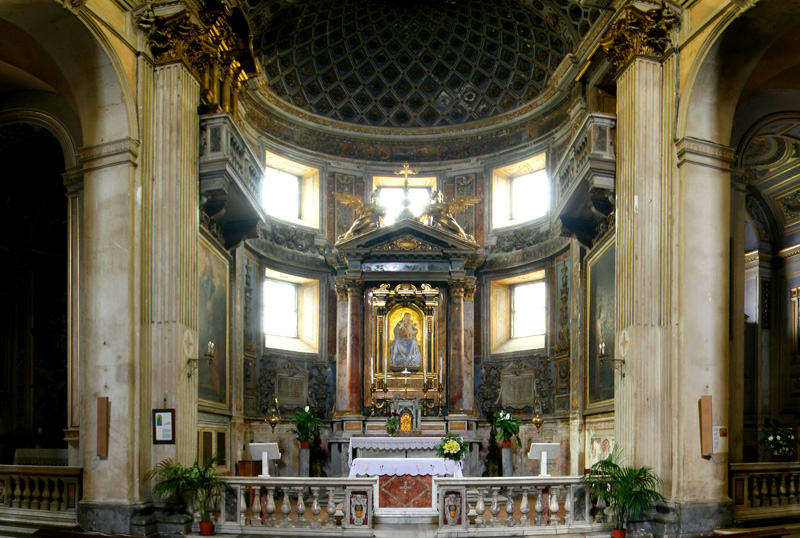
Maria in Monterone

This photo of the S Maria in Monterone is part of one of the panoramic images found on the PanoramicEarth.com Tour of Rome. There are over 100 images taken from around Rome linked to an interactive map.

Full 360° panorama of Santa Maria in Monterone

There are hundreds of churches in Rome dedicated to Mary, so I was bound to misplace at least one of them. This little church is fairly close to the Pantheon and I forgot to note down the full name when I took the images. In the end it has been identified as S. Maria in Monterone with the help of Anthony.

There is little information available about the S. Maria in Monterone and it is not mentioned in many of the guide books, so if anyone has some information about it the please feel free to add it as a comment. What I have manage do dig up is:

Documents indicate a church S Maria in Monterone was here as far back as 1186, the name Monterone coming from the family who owned the Palazzo Sinibaldi in front of it and built a hospice adjoining the church. It has been modified many time and in 1597 was raised slightly to avoid being affected by flooding from the Tiber. Radical changes were made in 17C and yet more in the early to mid 19C. A chapel of St. Alfons was installed in 1848. In spite of all these changes the aisles are partitioned from the nave by eight columns which used to belong to the Theatre of Pompeus that stood here before.

The church is associated with an Archconfraternity called the "Archconfraternity for the Relief of the Poor Souls in Purgatory under the title of the Assumption of Mary in the Redemptorist church of Santa Maria in Monterone at Rome", which, founded in 1841 has responsibility for saying prayers and collecting indulgences to shorten the plight of those in purgatory. While pope Benedict XVI recently abolished the dogma of limbo, the idea of purgatory still remains.

Thanks are due to liciano! for helping to identify this church. A full panoramic image of the inside of SS Nome di Maria is found on the Rome tour by PanoramicEarth.com. An enlargement of this photo can be found on Flickr where you can also find images of the Right and Left side chapels near the high altar.

For more articles on Rome see the Rome Index or select one of the labels at the bottom.
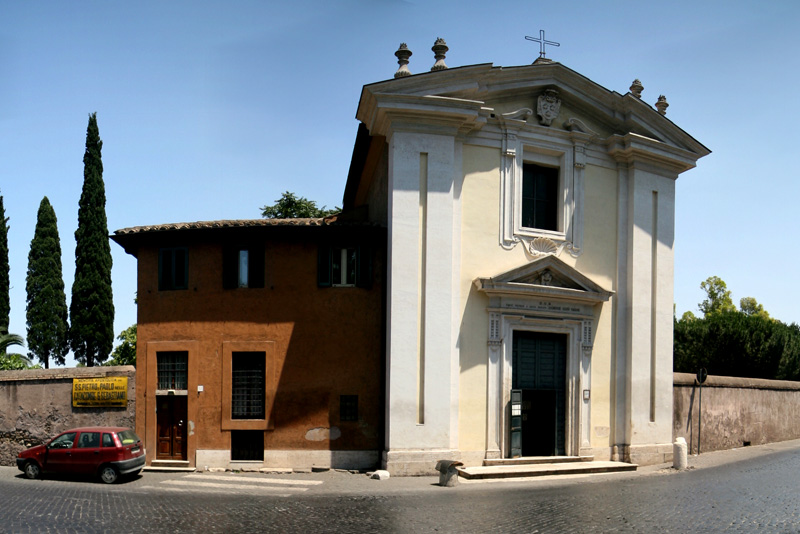
Domine Quo Vadis - Rome

Domine Quo Vadis (also called Chiesa di Santa Maria in Palmis), Rome

This photo of the Domine Quo Vadis is part of one of the panoramic images found on the PanoramicEarth.com Tour of Rome. There are over 100 images taken from around Rome linked to an interactive map.

Full 360° panorama of the Domine Quo Vadis

The name of this building intrigued me as soon as I saw it on the map of Rome I was using. The idea of naming a house ‘Lord where are you going’ was not one I had come across before. Domine Quo Vadis is situated about 800m from the St. Sebastian Gate (Porta San Sebastiano) outside the Aurelian Walls south of Rome on the Apian Way, one of the most important roads in ancient time. It is in fact a church, which was undergoing renovation at the time I visited so I was unable to take any images inside.

The official name of the church is Chiesa di Santa Maria in Palmis, though virtually no one refers to it as such. The name Domine quo vadis comes from an encounter St. Peter reputedly had with Jesus when he was fleeing Rome. According to legend, Peter asked the question of Jesus who replied that he was returning to Rome to be crucified anew.

There has been a sanctuary on the spot since the 9th century, but the current church is from 1637 and façade added later on in the 17C. It may have previously been the location of Campus Rediculi, a temple to the god or Return. Situated at the junction of the Via Ardeatina with the Apian Way (one of the main consular routs of Rome) it was the last place where a traveler could look back and see the walls of Rome.

Inside the church are a pair of footprints sunk into a marble slab. These are claimed to be the impressions made by Jesus when he mat Peter on the Apian way. It is most likely that this is in fact a pagan offering made in thanks for a successful journey before the church was ever here.

In the catacombs of Saint Sebastian there are inscriptions about a "Domus Petri" (house of Peter) which may support a claim that Peter lived in the area when in Rome. The catacombs are nearby up a hill.

An enlargement of this photo can be found on Flickr.

For more articles on Rome see the Rome Index or select one of the labels at the bottom.
Thursday, October 12, 2006

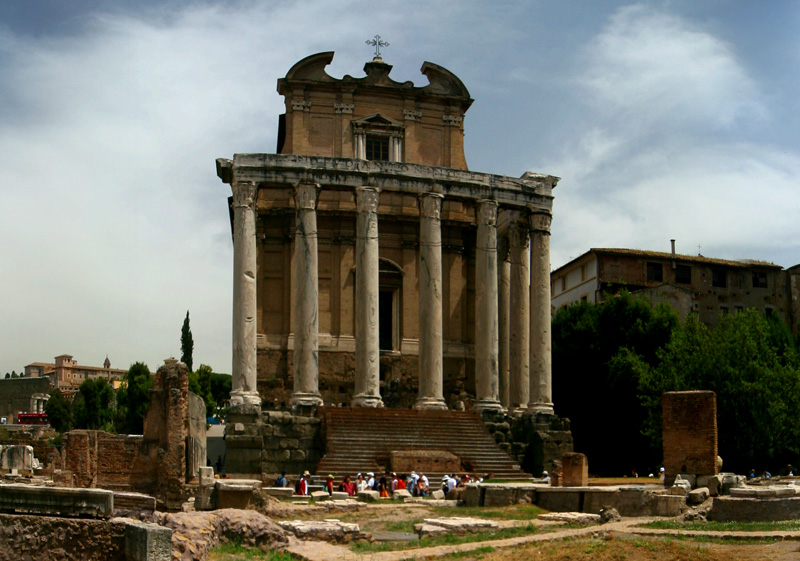
San Lorenzo in Miranda - Roman Forum

San Lorenzo in Miranda, formerly the Temple of Antonius and Faustina - Roman Fourm

This photo of the San Lorenzo in Miranda is part of one of the panoramic images found on the PanoramicEarth.com Tour of Rome. There are over 100 images taken from around Rome linked to an interactive map.

Full 360° panorama of San Lorenzo in Miranda

San Lorenzo in Miranda (aka: Temple of Faustina and Antonius) is found in the Roman Forum about half way along the Sacra Via. This area is often full of people snaking their way along the paths behind tour guides waving various umbrellas and sticks in the air as group markers. The lines are so long that some guides have resorted to wireless headsets to communicate, meaning that those at the end must surely by one or two sights behind the current commentary.

San Lorenzo in Miranda started off as the Temple of Antonius and Faustina, and is one of the best preserved temples in the Forum. It was built around 140 and dedicated to Empress Faustina and then to her husband Antonius Pius after his death in 161.

In may have become a church in 7C, and is thought to be the place where S Lorenzo (St. Lawrence) was sentenced to death during the persecution of Christians by Valerian in 258. He is often portrayed as being burnt alive in a gridiron and his death may have had a profound impact in Rome furthering Christianity. This persecution also resulted in the crucifixion of Sixtus II the bishop and pope of the time. The Miranda part of the name may be either recognition of a benefactor at the time, or a derivation of ‘admire’ referring to the view over the Forum from the top of the steps.

The front shows the original pagan dedication DIVO ANTONINO ET / DIVA FAUSTINAE EX S(ENATUS) C(ONSULTO) (to the divine Antoninus and the divine Faustina by decree of the Senate). This is very unusual for a converted temple, normally evidence of pagan worship was destroyed, and the columns show marks of chains which were at one time used to try to topple them. The reconstructed flight of stairs up the front of the church may allow access to the pronaos and the pillars, but access to the interior is from the rear, through the College of Chemists and Pharmacists.

Unfortunately the church is often closed, though if you manage to get inside (possibly from 10-12 on a Thursday) you will find a single nave under a white barrel-vaulted ceiling with 3 side chapels. Above the high altar is the Martyrdom of St Lawrence by Pietro da Cortona, painted 1636-1646. This is framed by an aedicula of four black marble columns.

Full panoramas from the Roman Forum are found on the Rome tour by PanoramicEarth.com. An enlargement of this photo can be found on Flickr.

For more articles on Rome see the Rome Index or select one of the labels at the bottom.
Wednesday, October 11, 2006

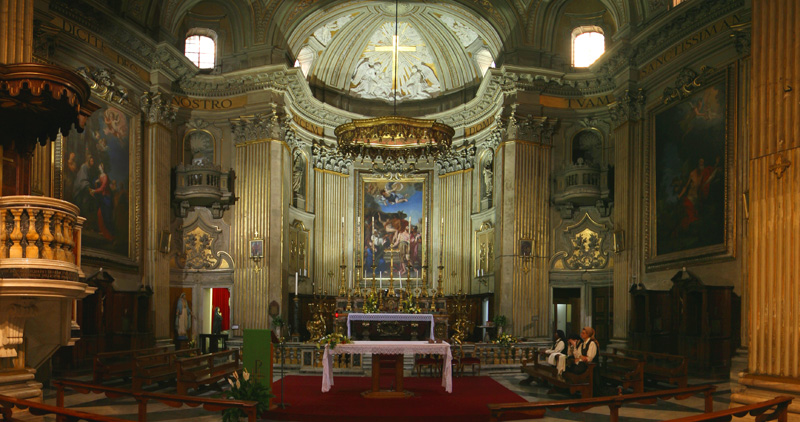
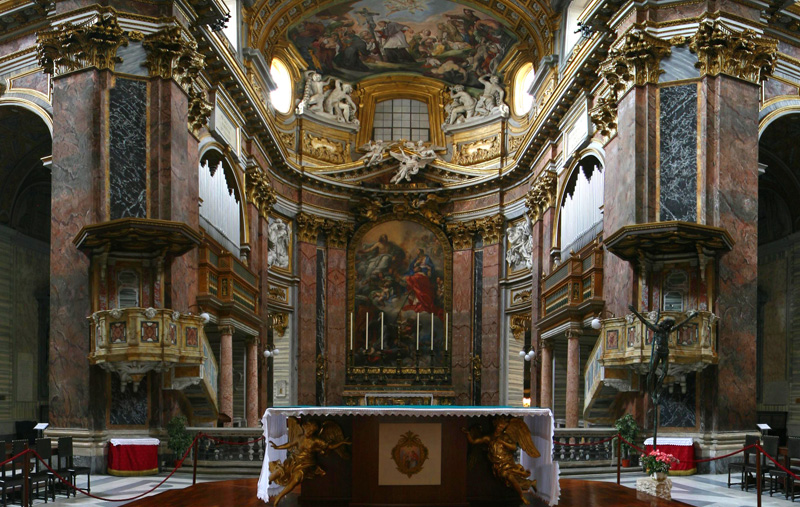
Santi Ambrogio e Carlo al Corso

Church of S Ambrogio e Carlo in Rome

This photo of the Santi Ambrogio e Carlo al Corso is part of one of the panoramic images found on the PanoramicEarth.com Tour of Rome. There are over 100 images taken from around Rome linked to an interactive map.

S Ambrogio e Carlo (Ambrose and Charles) is a fantastically ornate church situated on Via del Corso, about half way between Piazza del Popolo and Piazza Venezia. It is very close to the Piazza di Spangna. The church was built in the 17C by Onorio Longhi for the Lombard community in Rome and dedicated to the two canonized bishops of Milan, the capital of the Lombard movement. It replaces an earlier 15C building.

The interior has a Gothic architectural style, resembling the style of the Duomo in Milan. While sumptuous the ‘marble’ pillars are fake. It is the only church in Rome to contain an ambulatory, where the aisles encircle the sanctuary. The altarpiece shown here from 1685 and shows both Ambrogio and Carlo (Ambrose and Charles). St Charles' heart is preserved in the chapel found behind the altar in a richly decorated reliquary. The relics of a Roman martyr St Saturninus are interred in the altar. This is almost the internment of the unknown martyr since nothing more is known about him.

To the left of the altar the Chapel of St Olav of Norway, the martyr king who was slain in the Battle of Stiklestad in 1030. The king was a Viking I his youth and the painting depicts his victory over his own past, represented by a dragon. It was given to Pope Leo XIII for the 50th anniversary of his episcopal ordination. Bishop Fallize of Norway asked that it be placed in this church, where an altar had been set aside. Leo XIII supported this idea of a Norwegian chapel in Rome, permitting the painting to be placed here.

A full panoramic image showing the inside of S Ambrogio e Carlo, and the Chapel of Olav is found on the Rome tour by PanoramicEarth.com. An enlargement of this photo can be found on Flickr.

For more articles on Rome see the Rome Index or select one of the labels at the bottom.
San Clemente in Laterano

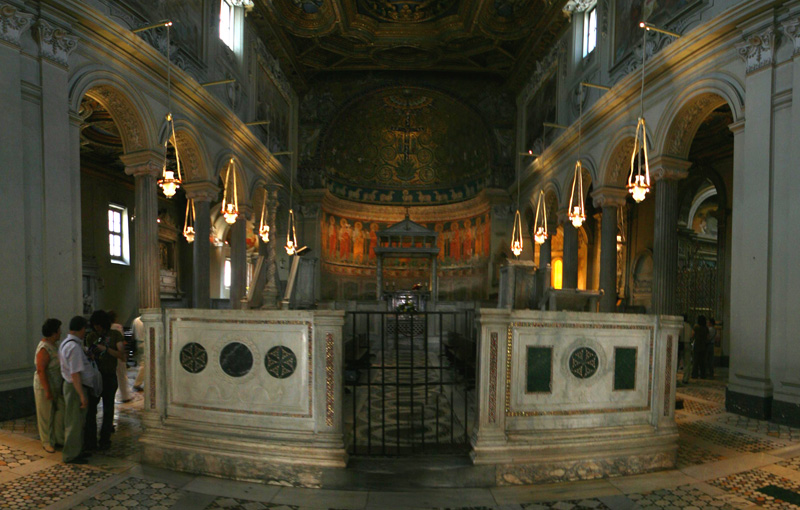
San Clemente in Laterano

This photo of the San Clemente in Laterano is part of one of the panoramic images found on the PanoramicEarth.com Tour of Rome. There are over 100 images taken from around Rome linked to an interactive map.

Full 360° panorama of the Basilica di San Clemente

San Clemente
lies almost hidden on the Via San Giovanni in Laterano, which connects the Colosseum with San Giovanni in Laterano. It is easy to pass the church without much of a second thought as the entrance is inconspicuous and set into a bland wall. In fact the entrance is a side door, which opens directly into the basilica. The plain façade and main door is off to the right, and opens onto a pleasant courtyard or quadroporticus, one of the few remaining, in which concerts are sometime held.

The first church on site here dates from 4C, but was burned down in by the Normans and then rebuilt in 1108. Since 1667 the Irish Dominicans have been the caretakers of San Clemente after being outlawed and evicted from Britain. The building has both an upper and lower church.

The ceiling of the upper church is decorated with the Triumph of St Clement, and in the center of the nave stands the choir stalls, as seen here in the picture. This also contains the Schola Cantorum which originally was found in the lower church. Behind this you can just see a baldacchino. The apse and area around the altar is packed with 12C mosaics, most obvious here are the 12 companions and Lamb of God that follow the curve. Above these symbols of aspects of Christianity.

Off to the right, at the end of the aisle, is the chapel of St. John the Baptist which contains a 16C statue by the same name. Both this and the other chapels in the church contain numerous frescoes and paintings throughout the ages.

If all this history was not enough, the lower church holds yet more. You descend to a frescoed narthex into a structure dating from the late 1C. This structure contains in inscription claiming it to be the property of T.Flavius Clemens. It may have at one time been part of a home that functioned as a meeting place for Christians, a common practice in early Christianity. Some frescoes and other works of art here are over 1,600 years old. The first basilica was built here over a Mithraeum, a shrine to Mithras, a god popular with the Roman Army but fell out of favor during the time of Constantine. The Mithraeum is still accessible, as are parts of other walls and structures dating from the 1C.

A full panoramic image showing the inside of S Clemente (upper church) and the entrance to the lower church is found on the Rome tour by PanoramicEarth.com. An enlargement of this photo can be found on Flickr.

For more articles on Rome see the Rome Index or select one of the labels at the bottom.
S Eugenio

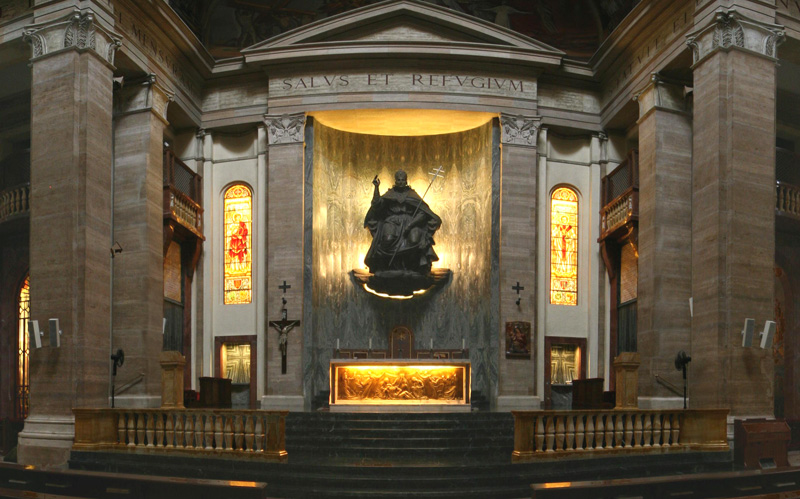
Altar of S Eugenio in Rome

This photo of the S Eugenio is part of one of the panoramic images found on the PanoramicEarth.com Tour of Rome. There are over 100 images taken from around Rome linked to an interactive map.

My mode of transport in Rome was a cycle. This can be fantastic for getting around the city quickly, but the cobbles can play havoc with your rear. I came across the church of S Eugenio on the way back from the Galleria Nazionale d’Arte. The church is located near to the Via Flamina, which used to be one of the main arteries for travelers visiting Rome, ending at the Piazza del Popolo.

S Eugenio is a modern building, built under the orders of Pope Pius XII, who was christened Eugenio Pacelli, and dedicated to the patron saint of his name. Funds were raised from the gifts the pope had received from the Silver Jubilie of his episcopate (started in 1942), and the altar was consecrated in 1952.

S Eugenio is built in a Baroque style though with some updating. Above the altar is the in an alcove is a statue of the pope, which the face of the altar depicts the removal of Jesus from the cross. The church also contains some reasonable frescoes in some of the side chapels, especially in those dedicated to Sts Peter and Paul and the chapel of Our Lady at Fatima.

A full panoramic image showing the inside or S Eugenio’s is found on the Rome tour by PanoramicEarth.com. An enlargement of this photo can be found on Flickr.

For more articles on Rome see the Rome Index or select one of the labels at the bottom.
Tuesday, October 10, 2006

Il Gesù - Principal Jesuit Church, Rome

Chiesa del Sacro Nome di Gesù, Principal Jesuit church in Rome

This image of the altar in Il Gesù in Rome is part of one of the panoramic images found on the PanoramicEarth.com Tour of Rome. There are over 100 images taken from around Rome linked to an interactive map.

The Church of Gesù is the principal church of the Jesuit order. The full Italian name is Chiesa del Sacro Nome di Gesù, or "Church of the Holy Name of Jesus". The Church of the Gesù is located in the Piazza del Gesù in Rome, at the beginning of the Corso Vittorio Emanuele which links the church to the Vatican, crossing over Ponte Vittorio Emanuele.

The layout of the church set a pattern followed by other Jesuit church buildings well into the 20C. Designed by Vignola, building began in 1568 and contained various new innovations in church design. These included the lack of aisles in the nave, and no narthex, thus the visitor enters the body of the building with attention given to the high altar.

The vault of Gesù is decorated with the fresco Triumph in the Name of Jesus. The church contains a number of side chapels in which various famous works of art are found. The most important is the Chapel of St Ignatius in the left transept, designed by Andrea Pozzo, SJ, in 1695-1699. More than 100 artists have contributed to the chapel over. The relics of the saint are contained within a gilded bronze urn from 1637 by Alessandro Algardi underneath the altar. The monument is crowned by the Holy Trinity, and the globe held by the Father is a single piece of lapis lazuli.

Several works celebrate the expansion of the faith and victories of the church. These include Théudon's Baroque sculpture Triumph of Faith over Heresy, and Barbarians Adoring the Faith by Jean Baptiste Théodon.

Next to this is the chapel of Santa Maria degli Astalli which contains the15C painting Madonna dell Strada (Madonna of the Road).

A full panoramic image showing more of the interior of Il Gesù is found on the Rome tour by PanoramicEarth.com. An enlargement of this photo can be found on Flickr.

For more articles on Rome see the Rome Index or select one of the labels at the bottom.
Monday, October 09, 2006

Pantheon in Rome

Pantheon in Rome - Inside

This view over the Pantheon is part of one of the panoramic images found on the PanoramicEarth.com Tour of Rome. There are over 100 images taken from around Rome linked to an interactive map.

Full 360° panorama of the Pantheon

The Pantheon survives virtually intact from ancient Roman times. It was originally dedicated to ‘all the gods’ – pan theon. The area in which it stands was a favorite Roman promenade filled with gardens and temples. The Pantheon we see today is the result of a building programme by Emperor Hadrian in 128 AD.

The survival of the Pantheon is credited, among other things, to two strokegs of fortune. It was the first pagan temple to be converted into a church, in 609, and in 734 pope Gregory III lined the roof with lead thus helping preserve it. However, the Pantheon, now dedicated to S Maria ad Martyres, did not survive unscathed and in 667 the Byzantine Emperor Constans II nicked all the bronze he could find in Rome including that lining the Pantheon to be melted down for coins in Constantinople.

However, when possible the popes always took care of this earliest church in Rome. The interior is stunning. Sunlight (and rain) pours through the oculus in the centre of a dome slightly larger than that at St. Peter’s. The interior is lined with lush marble and almost entirely intact in it’s original form except for the statues that used to line the alcoves. The bronze doors into the Pantheon were rebuilt by pope Pius IV in 1563, but later Bernini pillaged the bronze from the roof (again) to make the baldacchino at St Peter’s and 80 cannons for Pope Urban to install in Castel Sant’Angelo.

The Pantheon in Rome is hugely popular with tourists. Come here any time after 10am and you are likely not to be able to see the floor for the people, which is a shame as the marble floor is well worth it. In fact, all you will be able to see are groups of 100 or so people weaving their way among each other as they follow guides holding up umbrellas or poles with emblems on the top of them. Every so often a voice forlornly calls out in six or so languages urging people to be quiet. So if you actually want to see the Pantheon properly, then you have to get there when it opens.

Thus the part of the panoramic shown here was taken at around 8:30 in the morning when the place was relatively quiet and before trying to get quickly to St Peter’s for the same reason. The full panoramic image shown on the Rome tour by PanoramicEarth.com. For better appreciation of this image go to the collection on Flickr.

For more articles on Rome see the Rome Index or select one of the labels at the bottom.
Friday, October 06, 2006

S Bonifacio e Alessio

S Alessio in Rome

This image from Santi Bonifacio e Alessio is part of one of the panoramic images found on the PanoramicEarth.com Tour of Rome. There are over 100 images taken from around Rome linked to an interactive map.

The name of this church is often abbreviated to S Alessio. It is named after Alexius who was killed by being pushed down some stairs. He was the only son of Euphemianus, a wealthy Christian Roman of the senatorial class. Alexius fled an arranged marriage to pursue his vocation, ending up in Edessa, Syria. Slaves were sent to look for him but did not recognize him living as a beggar.

Eventually he was singled out as a “Man of God” and fled back to Rome to live, unrecognized, with his parents who, as Christians, took him in for 17 years. He spent this time hiding under the stairs and teaching the faith to children. Documents found after his death revealed who he really was. A portion of a staircase is set into a 17C altar at the west end of the left aisle, supposedly the very one Alexius lived under.

Originally a home the site was converted into a church in 5C, but has undergone many revisions. The interior is painted in pastel colours and, while plain compared to many churches, has an airy and free feel to it. The façade is from 18C with 5 arches and a five-storey bell tower dating from 1217. The church also contains a well from the Alessio family and a Byzantine Madonna of the Intercession brought to Rome in the 10C.

The image here shows the main altar within the church. The full panoramic image shown on the Rome tour by PanoramicEarth.com.. For better appreciation of this image go to the collection on Flickr.

For more articles on Rome see the Rome Index or select one of the labels at the bottom.
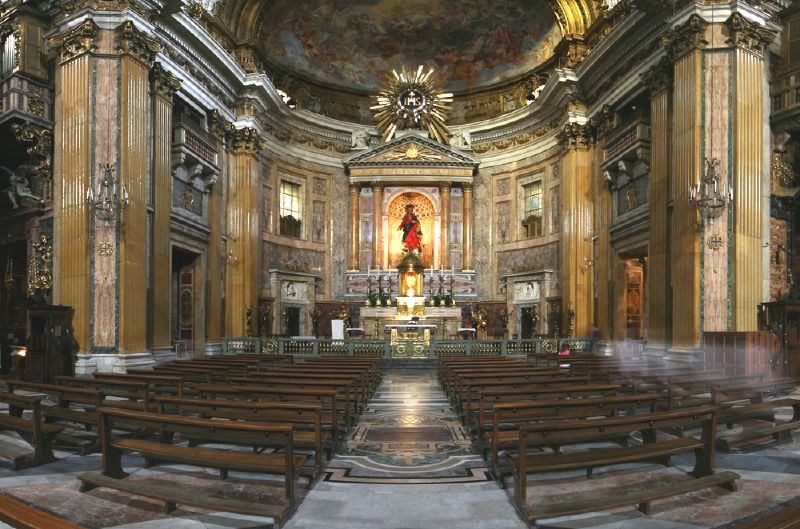
Rome - Thanks where it is due

Piazza S Pietro in Rome

It is one thing visiting a place and spending time taking lovely photographs. It is totally another to then try to remember where they all were or even what the places were called. I enjoy sites like Flickr, but so often title of ‘Church’ or ‘Statue’ does not really help in understanding where the image was taken. I like to have relevant titles on things, maybe that comes from my scientific training. I may even like to give a one liner (or more for the posts here) about them. It is at that time that I reach for the sources

In putting together the information on Rome I have used a number of sources. Among these are some travel guides, all of which contain both the same information and then separate snippets. These included guides from Cadogan, Eyewitness, Blue Guide and a Times Bartholomew Guide.

Naturally in addition to this the website has been an invaluable resource. I would like to thank all of those who have contributed to Churches in Rome on Wikipedia, and also the valuable information compiled on roma.katolsk.no, which is looks like being a very thorough personal labour of love. These are the kind of sites that deserve to be at the top of search engine results, far more than the ‘reviews’ given on travel sites.

In putting together the descriptions for both here and Panoramic Earth I have also gained far more understanding and appreciation for the places I have been to than if I were merely compiling a photo album.


S Bernardo Church Rome http://www.panoramicearth.com

Thursday, October 05, 2006

San Bernardo alle Terme

S Bernardo alle Terme church in Rome

This image from San Bernardo alle Terme is part of one of the panoramic images found on the PanoramicEarth.com Tour of Rome. There are over 100 images taken from around Rome linked to an interactive map.

Full 360° panorama of the church of S Bernardo alle Terme

The church of S Bernardo alle Terme is quite small and tucked away opposite S Maria della Concezione on the Via XX Septembre. The outside is painted a pastel pink colour. The church is circular in design, set into one of the circular halls that stood at the corners of the Diocletian Baths that may have been a temple. Unfortunately the area in front of the church has been converted into a very crowded and unattractive parking lot. Diagonally across the street is S Maria della Vittoria.

Built in 1598 it was given to a French Cistercian group called the Feuillants. San Bernardo alle Terme is similar in design to the Pantheon, being cylindrical with a dome and an oculus some 22m across. The dome decoration is made of octagonal coffers. The main focus of the interior are eight statues of saints housed in niches of the walls by Camillo Mariani. There are also two side altars dedicated to St Bernard and St Robert of Molesmes, co-founders of the Cistercian Order.

The German painter Johann Friedrich Overbeck who founded the Nazarene art movement, is interred here and off to one side is the Chapel of St Francis that was added to the ancient rotunda.

The image here is part of a panoramic showing the main altar flanked by the two side altars with 4 of the eight statues set into niches. The full panoramic image shown on the Rome tour by PanoramicEarth.com. There is a larger version of this image of S. Barnardo alle terme on Flickr.

For more articles on Rome see the Rome Index or select one of the labels at the bottom.
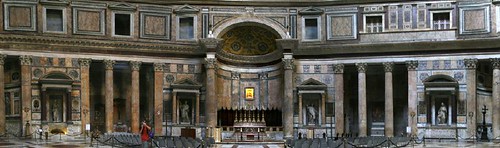
S Giovanni in Laterano Basilica, Rome

Basilica S Giovanni in Laterano in Rome

This image from S Giovanni in Laterano in Rome is part of one of the panoramic images found on the PanoramicEarth.com Tour of Rome. There are over 100 images taken from around Rome linked to an interactive map.

S Giovanni in Laterano is one of the most important churches in Rome. It is in fact the cathedral of Rome and up until 1870 was the site where the Popes were coronated. As the cathedral of the Bishop of Rome, containing the papal throne (Cathedra Romana), it ranks above all other churches in the Roman Catholic Church, even above St. Peter's Basilica in the Vatican. Though receiving far fewer visitors than St. Peter’s the effort is well worth while. The first thing to strike the visitor is the immense size, S Giovanni in Laterano is 130m long with two aisles either side.

There are two entrances. It is almost more revealing to enter through the North Façade into one of the transepts. This provides a glimpse of the Papal Altar, but obscures much of the nave from immediate view. As you approach the nave the whole comes into view. The main entrance is in the East Façade.

The name comes from the patrician Lateranus family who were accused of conspiracy against Emperor Nero. Nero confiscated their property and executed some of the family members. In 4C the property came into the hands of Constantine who arranged for a church to be built here. The church has retained its original plan, although the interior dates from 1649 having been destroyed by fire on several occasions. The east façade was added in 1734.

In the apse of the church is the Papal Throne. The Papal Altar in the middle of the transepts is a Gothic baldacchino dating from the 14C. Attached to the church is an important museum containing many artifacts.

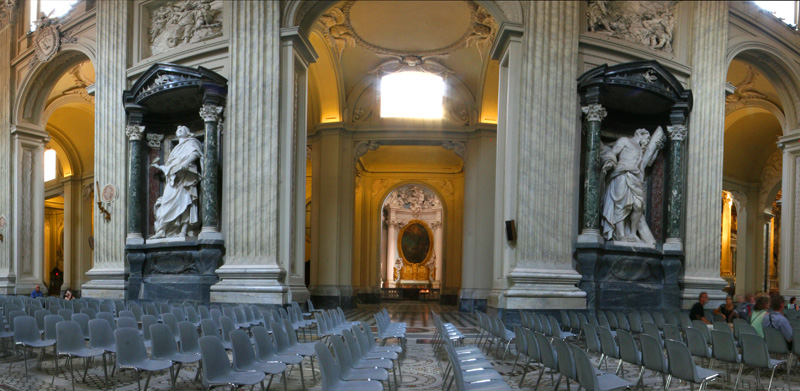
This image shows some of the huge 8m statues that line the nave in alcoves framed by massive pillars. There are 12 of them, one for each of the Apostles and date from the early 18C. Above them are stuccoes depicting scenes from the Old Testament. The full panoramic image shown on the Rome tour by PanoramicEarth.com. For better appreciation of this image go to the collection on Flickr.

For more articles on Rome see the Rome Index or select one of the labels at the bottom.
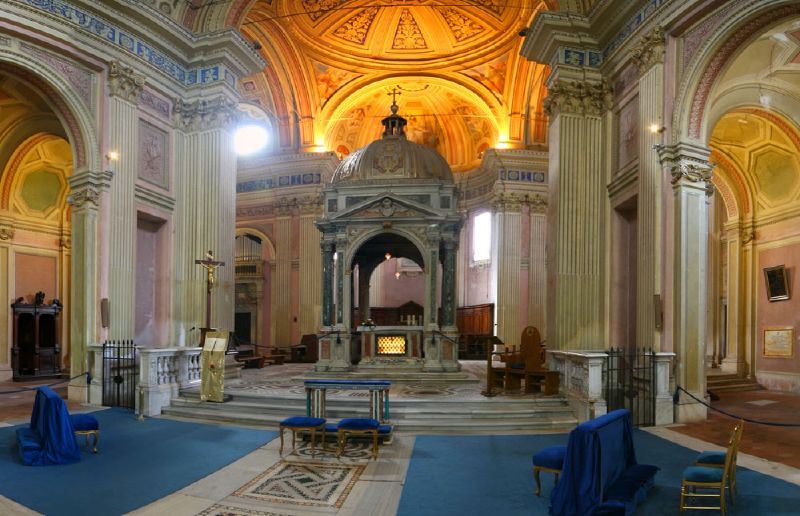
Wednesday, October 04, 2006

Chruch of Santa Maria degli Angeli e dei Martiri, Rome

Santa Maria degli Angeli e dei Martiri

This image of Santa Maria degli Angeli e dei Martiri in Rome is part of one of the panoramic images found on the PanoramicEarth.com Tour of Rome. There are over 100 images taken from around Rome linked to an interactive map.

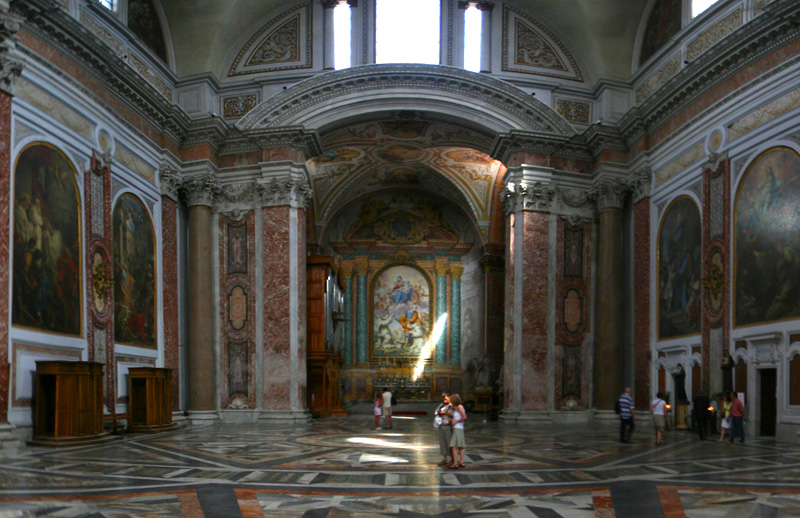
Santa Maria degli Angeli e dei Martiri is on the Piazza della Republica., Like so many of the churches in Rome, it is built upon a supernatural event. In 1541 a Sicilian priest, Fr. Antonio Lo Duca, had a vision of angels in the ruins of the Diocletian Baths, and in the 1560’s Pope Pius IV ordered a church to be built there. The resulting church was not only built on the site of the Baths of Diocletian, but also recycled some of the building materials, adapting the Baths for the new use. Michelangelo provided the original design for the church.

Major alterations to the church were carried out in 1749 by Luigi Vanvitelli in preparation for the Holy Year of 1750. The interior of S Maria delgi Angeli still follows the layout of the Baths, however he installed a new front entrance in the long southwest side of the church thereby converting the nave into a huge transept. This transept is 100m long, 27m wide and 28m high. There are 8 huge red granite, 14m high columns which are original. On the right near the entrance to the transept is a large statue of St Bruno.

The Meridian Line
The Basilica also contains an unusual astronomical installation. In the right hand side of the transept is a meridian line, a sort of sundial. It was built on the order of Pope Clement XI by Francesco Bianchini. The meridian line had a 3-fold purpose:
(1) the pope wanted to check the accuracy of the Gregorian reformation of the calendar,
(2) to produce a tool to exactly predict Easter,
(3) to give Rome a meridian line as important as the one Bianchini had recently built in Bologna's cathedral, San Petronio.

There were several reasons for choosing Santa Maria degli Angeli e dei Martiri as the location for this project:
(1) The church was orientated to the south and received unobstructed exposure to the sun
(2) The high walls allowed for a longer line resulting in more accurate measurements.
(3) The walls are ancient, and were thus unlikely to settle of move any further]. This meant that carefully calibrated observational instruments set in them would not move out of alignment.
(4) Because it was set in former pagan site, it would represent a victory of the Christian calendar over the earlier pagan calendar.

Bianchini also added holes in the ceiling to allowing one to observe not only the sun but also to mark the passage of stars. Polaris, Arcturus and Sirius are visible through these holes even during the day. The meridian line was restored in 2002 for the tricentenary of its construction.

This Picture:
The view in this image is taken from near the centre of the transept looking towards the north end. The volume of space and size of the pillars dwarfs the people in the picture. The painting above the altar is The Apparition of the Virgin Mary to St Bruno by Giovanni Odazzi. The organ to the left of the altar was built in the 1990’s. The whole image is found on the Rome tour by PanoramicEarth.com.

For more articles on Rome see the Rome Index or select one of the labels at the bottom.

Tuesday, October 03, 2006

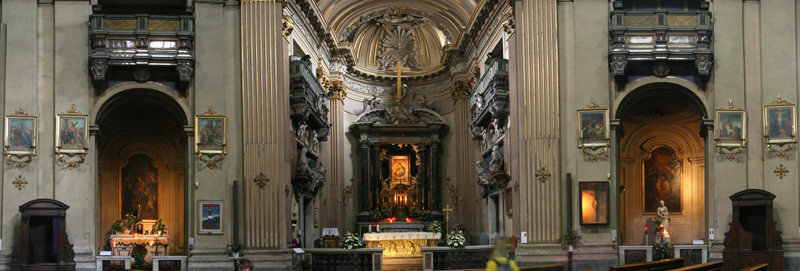
Church of S Maria dei Miracoli in Rome

Church of S Maria dei Miracoli in Rome from http://www.panoramicearth.com

This image of Santa Maria dei Miracoli in Rome is part of one of the panoramic images found on the PanoramicEarth.com Tour of Rome. There are over 100 images taken from around Rome linked to an interactive map.

The church of Santa Maria dei Miracoli is one of two twin churches which stand like sentinels at the beginning of Via del Corso as it leaves the Piazza del Popolo. The other church is the Santa Maria in Montesanto. They were built by Carlo Rainaldi, and, although the fronts of the two churches look identical, S Maria in Montesanto has an oval dome whereas S Maria dei Miracoli has a circular dome. This was done because the churches had to look the same to provide a focal point for the Piazza, but the site for S Maria dei Miracoli is slightly narrower.

S Maria dei Miracoli took six years to build, starting in 1675. and built to a circular design with an octagonal cupola. Inside are sculptures by Antonio Raggi.

In this image you can see the high altar and two side chapels. Above the high altar is an image of Mary.The whole image is found on the Rome tour by PanoramicEarth.com. The first chapel on the right-hand side has an altar dedicated to Our Lady of Bétharram, named after a shrine near Lourdes. It contains a mediocre copy of Renoir's Madonna at Bétharram. The order of the Priests of the Sacred Heart, who minister in this church, were founded at Bétharram.

For more articles on Rome see the Rome Index or select one of the labels at the bottom.
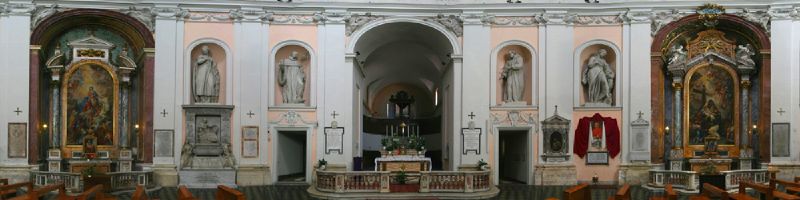
Church of Santa Maria del Popolo in Rome

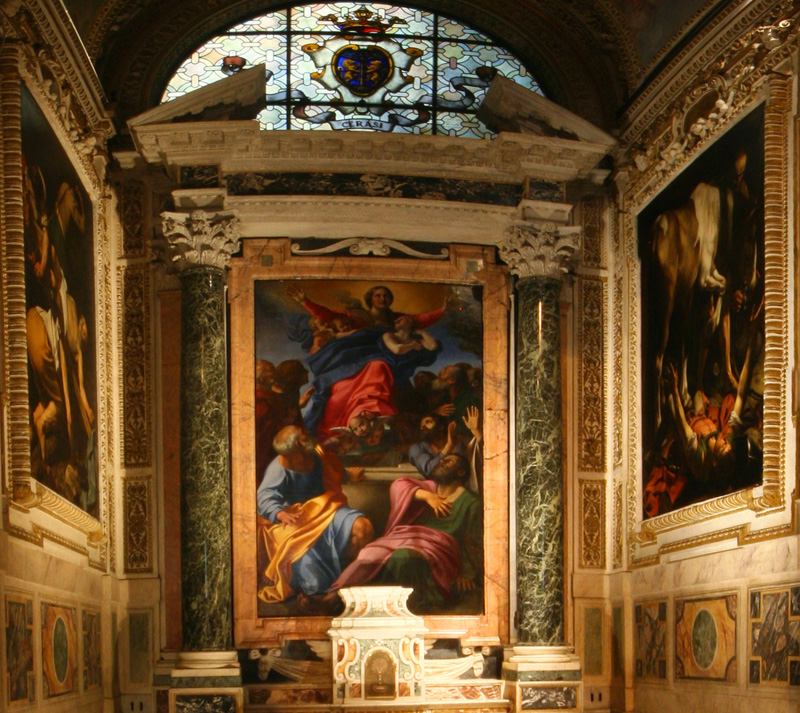
S Maria Del Popola - Cerasi Chapel

This image of Santa Maria dela Popolo in Rome is part of one of the panoramic images found on the PanoramicEarth.com Tour of Rome. There are over 100 images taken from around Rome linked to an interactive map.

The Ghost of Nero
The church of Santa Maria del Popolo is linked to a ghost story. It started as a chapel erected over the tombs of the Domitia family. Nearby was a walnut tree inhabited by ravens. It was believed that the tree was inhabited by the ghost of Nero, and that the ravens were demons sent to torment him. On building the chapel in 1099 Pope Paschal II cut the tree down. And that was the end of that.

The chapel was dedicated to Mary, and funded by the people of Rome, hence the name Poplo. It was rebuilt twice more and the current building dates from the late 15C. Like many other churches in Rome, that of S Maria del Popolo contains a large number of artifacts important to both the religious and arts fraternities. To list them all would make for lengthy reading, but they include the Crucifixion of St Peter and the Conversion of St Paul in the Cerasi Chapel, painted by Caravaggio in 1600.

Within the church are several other chapels, many funded by rich families. These include the Chigi Chapel with a series of mosaics in the dome depicting God creating 7 heavenly bodies known at this time, each of which was guided by an angel.

Politics and Intrigue
The church is also the burial site for Ascanio Sforaz who arranged the marriage of the illegitimate daughter of Pope Alexander VI (conceived before he became Pope) and subsequently accused of the murder of the same Pope’s son. Ascanio tried to obtain the papacy 3 times during his lifetime but failed. He died age 50 and the tomb here was commissioned by Pope Julius II, the Warrior Pope who founded the Swiss Guards.

In recent times the church has been popularized as a setting for part of the Dan Brown novel Angels and Demons.

The image here shows the famous Assumption of the Virgin Mary, by Annibale Carracci which is above the altar in the Cerasi Chapel. The whole image is found on the Rome tour by PanoramicEarth.com.

For more articles on Rome see the Rome Index or select one of the labels at the bottom.
Santa Maria della Consolazione

S Maria Della Consolazione

This image of the church of Santa Maria della Consolazione in Rome is part of one of the panoramic images found on the PanoramicEarth.com Tour of Rome. There are over 100 images taken from around Rome linked to an interactive map.

Full 360° panorama of Santa Maria della Consolazione

Every church has a little history behind it’s founding, and the church of Santa Maria della Consolazione is no different. It is situated just behind the Forum, and is easily missed. I came across it on my way down from the Palazzo Conservatori.

The Death of the Condemned
The cliff above the church is thought to be the Tarpeian Rock from where condemned Roman criminals were tossed to their death in Roman times. The links between the condemned and this church continue. In 1385 a condemned nobleman, Giordanello degli Alberini, paid 2 gold florins for a picture of Mary to be placed on this site to provide consolation condemned criminals on their last journey. It was from this that the church and the road get their names. The first church was built here in 1470, and reconstructed between 1583 and 1600, during which time the Baroque façade was installed.

The Church:
The picture here shows the fresco of Madonna della Consolazione above the altar painted in the 14th Century by Antoniazzo Romano. 2 chapels can be seen leading off to the right and left of the altar. The one on the left contains a marble relief of the Marriage of St. Catherine by Raffaello da Montepulo and dates from 1530. The church has a total of 11 side chapels owned by both local noble families and craft guild members.

In 1506 a hospital was built nearby, and it was here that that St Aloysius contracted the plague while caring plague victims. This is commemorated by a plaque on the wall past the church. The hospital was demolished in 1936 and the site is now the HQ of the fire brigade.

The whole image is found on the Rome tour by PanoramicEarth.com. There is an enlargment of this picture from Santa Maria della Consolazione on Flickr

For more articles on Rome see the Rome Index or select one of the labels at the bottom.
New Panoramas on Panoramic Earth