Showing posts with label ancient. Show all posts

Friday, October 13, 2006

Circus Maximus - Rome

Circus Maximus - Rome

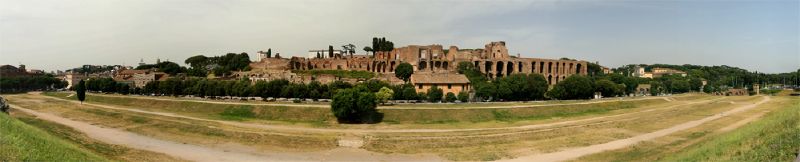
This photo of the Circus Maximus is part of one of the panoramic images found on the PanoramicEarth.com Tour of Rome. There are over 100 images taken from around Rome linked to an interactive map.

Full 360° panorama of the Circus Maximus

Unfortunately there is very little remaining of the Circus Maximus in Rome, very well known as the location of the chariot race in Ben Hur. It was far too convenient to plunder the building materials for other projects so this is now an open area used for walking dogs. It is a pitiful end to an arena which in it’s day could seat around 300,000 people, with almost the same number viewing from the surrounding hills.

There is evidence to suggest that the area of the Circus Maximus was first used by the Etruscan kings as a place for games as far back as 600 BC. It continued to be associated with public events and in 50 BC Julius Caesar expanded the arena. In 81, the Senate built a triple arch honoring Titus by the closed East end (not to be confused with the Arch of Titus on the opposite side of the Palatinum Hill near to the Colosseum and Roman Forum).

This was made for chariot racing, the track is about 600m long and 80m wide and could hold 12 chariots at a go. The two sides of the track were separated by a spina (spine) that ran down the center. At each end was a meta, a turning post the chariots would career round at dangerous speeds. The number of laps was marked by rotatable metal dolphins set along the top of the spina. The spina also supported various statues and Augustus placed an obelisk here (moved to Piazza del Popolo by pope Sixtus in 16C).

It is hard to imagine the chaos and confusion that must have resulted during the race, and the best depiction is probably still the chariot race in Ben Hur. Only one of the 12 chariots would survive the race, the others crashing at some point throughout. There was a dedicated crew whose only job was to remove the remains of ruined chariots and the dead and injured people and animals from the track without becoming track-kill themselves.

This image is taken from the lookout on the Via del Circo Massimo. Behind the Circus Maximus you can see the Palatine Hill and the ruins of Domitian’s Palace. Further panoramas from Rome are on PanoramicEarth.com. An enlargement of this photo can be found on Flickr.

For more articles on Rome see the Rome Index or select one of the labels at the bottom.

Temple of Romulus - Roman Forum

Temple of Romulus - Roman Forum

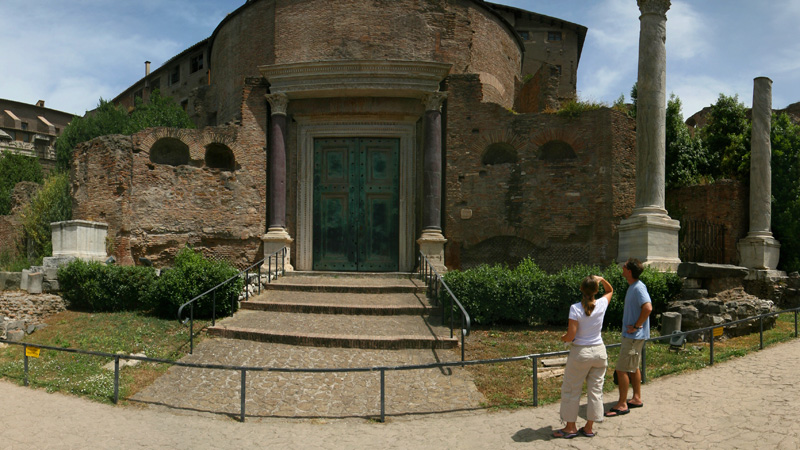
This photo of the Temple of Romulus is part of one of the panoramic images found on the PanoramicEarth.com Tour of Rome. There are over 100 images taken from around Rome linked to an interactive map.

Full 360° panorama of the Temple of Romulus

One of the most amazing things about the Temple of Romulus is the door. This is not just a green door, or even a green bronze door. This door dates from the late Imperial Age and is therefore almost 1,700 years old. To have survived intact for so long and through so much is almost unprecedented. This is one special door.

But enough about the door, what about the rest of the building? It is situated in the Roman Forum next to the Temple of Antonius and Faustina, and dates from the early 4C. Originally it was thought that this was dedicated to Emperor Romulus who died in 307. Recently it has also been suggested that the building may have been associated with the Temple of Jupiter or the audience hall of a city prefect.

Maxentius bagan building the Temple of Romulus, and it was completed by Constantine. That is in such good condition is thanks in part to the fact that in the Middle Ages it was incorporated into the atrium of the church of St. Cosma and St. Damiano. Inside the church is a 6C mosaic showing Jesus Christ surrounded by several saints at his second coming. The rest of the church has taken over the Forum Pacis built by Emperor Nerva.

Full panoramic images from the Roman Forum are found on the Rome tour by PanoramicEarth.com. An enlargement of this photo can be found on Flickr.

For more articles on Rome see the Rome Index or select one of the labels at the bottom.

Thursday, October 12, 2006

San Lorenzo in Miranda - Roman Forum

San Lorenzo in Miranda, formerly the Temple of Antonius and Faustina - Roman Fourm

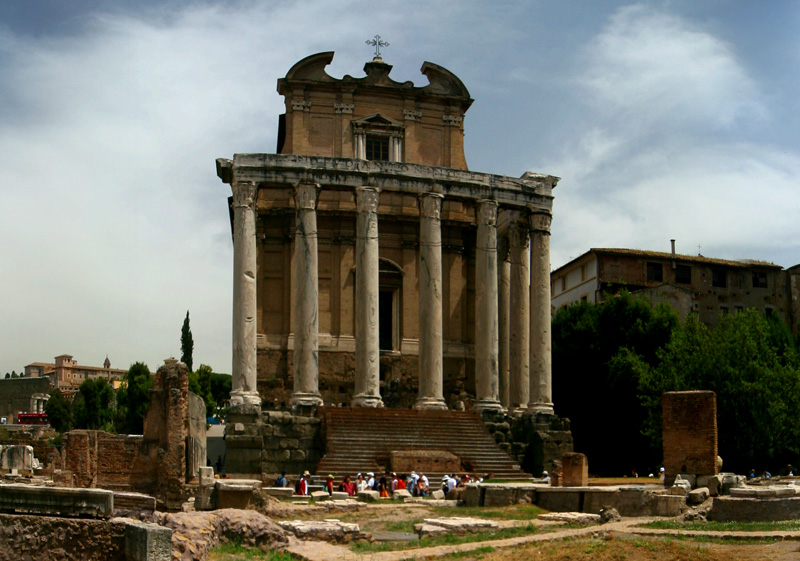
This photo of the San Lorenzo in Miranda is part of one of the panoramic images found on the PanoramicEarth.com Tour of Rome. There are over 100 images taken from around Rome linked to an interactive map.

Full 360° panorama of San Lorenzo in Miranda

San Lorenzo in Miranda (aka: Temple of Faustina and Antonius) is found in the Roman Forum about half way along the Sacra Via. This area is often full of people snaking their way along the paths behind tour guides waving various umbrellas and sticks in the air as group markers. The lines are so long that some guides have resorted to wireless headsets to communicate, meaning that those at the end must surely by one or two sights behind the current commentary.

San Lorenzo in Miranda started off as the Temple of Antonius and Faustina, and is one of the best preserved temples in the Forum. It was built around 140 and dedicated to Empress Faustina and then to her husband Antonius Pius after his death in 161.

In may have become a church in 7C, and is thought to be the place where S Lorenzo (St. Lawrence) was sentenced to death during the persecution of Christians by Valerian in 258. He is often portrayed as being burnt alive in a gridiron and his death may have had a profound impact in Rome furthering Christianity. This persecution also resulted in the crucifixion of Sixtus II the bishop and pope of the time. The Miranda part of the name may be either recognition of a benefactor at the time, or a derivation of ‘admire’ referring to the view over the Forum from the top of the steps.

The front shows the original pagan dedication DIVO ANTONINO ET / DIVA FAUSTINAE EX S(ENATUS) C(ONSULTO) (to the divine Antoninus and the divine Faustina by decree of the Senate). This is very unusual for a converted temple, normally evidence of pagan worship was destroyed, and the columns show marks of chains which were at one time used to try to topple them. The reconstructed flight of stairs up the front of the church may allow access to the pronaos and the pillars, but access to the interior is from the rear, through the College of Chemists and Pharmacists.

Unfortunately the church is often closed, though if you manage to get inside (possibly from 10-12 on a Thursday) you will find a single nave under a white barrel-vaulted ceiling with 3 side chapels. Above the high altar is the Martyrdom of St Lawrence by Pietro da Cortona, painted 1636-1646. This is framed by an aedicula of four black marble columns.

Full panoramas from the Roman Forum are found on the Rome tour by PanoramicEarth.com. An enlargement of this photo can be found on Flickr.

For more articles on Rome see the Rome Index or select one of the labels at the bottom.
Wednesday, October 11, 2006

Colosseum - The Outside

Colosseum or Colisseum, the Flavian Amphitheatre in Rome

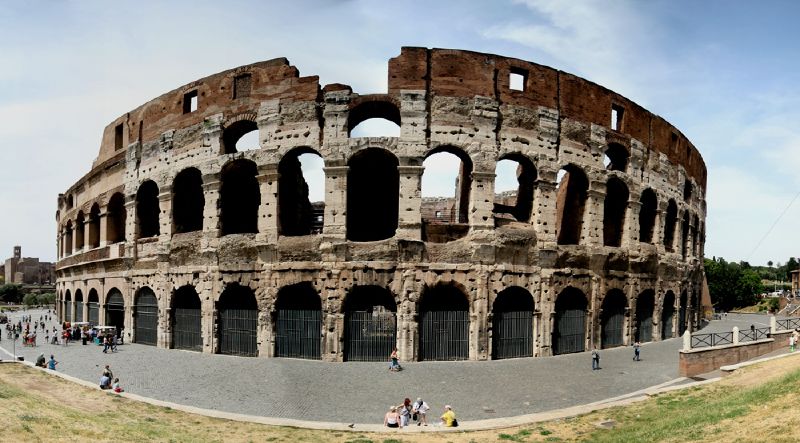
This photo of the Colosseum is part of one of the panoramic images found on the PanoramicEarth.com Tour of Rome. There are over 100 images taken from around Rome linked to an interactive map.

Even in a ruined state the Colosseum is impressive. A massive amphitheatre designed to hold some 50,000 people purely for the delight of seeing man and beast slaughtered in the sandy arena. Originally called The Flavian Amphitheatre after the Emperors of the Flavian family in Rome who built it, starting with Emperor Vespasian in AD 72. It was finished by Titus and the inauguration event involved a 100 day festival during which over 5,000 animals and 2,000 gladiators perished.

Although the structure is huge (an oval 188m long and 156m wide) the name comes from the Colossus of Nero, the largest bronze statue ever to have been built (it stood about 40m high) by the megalomaniac Emperor. It was transported here by 24 elephants after his death. It was then named after the sun god and the head was often changed to match the Emperor of the day. All that remains of it now is the base, fenced off near to the Arch of Constantine.

The Colosseum was partly built as a public relations exercise, the space it occupies used to be part of Nero’s private pleasure gardens, and Vespasian sought to gain favour by returning the site to the people. Building the largest amphitheatre in the world, right next to the Roman Forum, seemed like a good idea at the time. When constructed, the Colosseum originally stood in the middle of a lake.

Spectators would enter the Colosseum through one of 76 numbered entrances at ground level. Today these arches are locked with railings as shown here. Each ticket would specify the gate, tier and seat number and by all accounts ran much smoother than many large auditoria or football stadia do today. It was said that the 50,000 spectators could be seated within 10 minutes of opening up for the day. In fact all modern stadiums have copied the plan of the Colosseum to some degree.

Over time much of the stone work has been used for other projects, including St. Peter's Basilica in the Vatican. Nowadays a busy road runs around the Colosseum, but even this does not detract form the impact of the structure. Tickets to the Colosseum also allow entry to the Palatine Hill.

A full panoramic image showing the area around the Colosseum is found on the Rome tour by PanoramicEarth.com. An enlargement of this photo can be found on Flickr.

For more articles on Rome see the Rome Index or select one of the labels at the bottom.
Tuesday, October 10, 2006

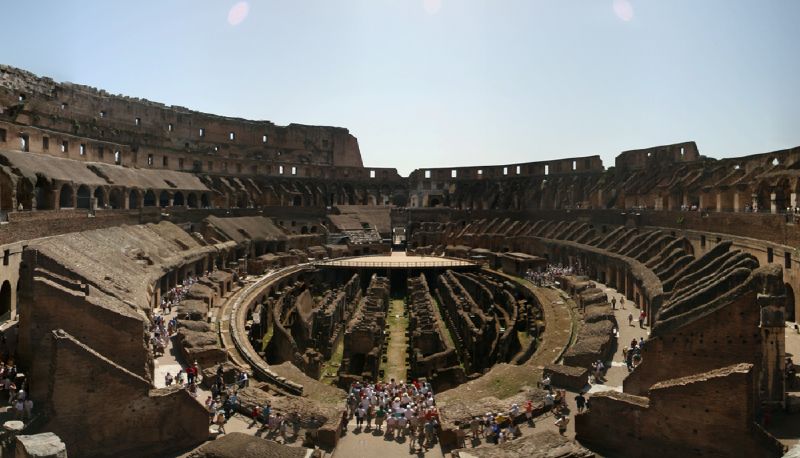
Colosseum of Rome - Inside

The Colosseum, Rome, inside view of the amphitheatre.

This photo of the Colosseum is part of one of the panoramic images found on the PanoramicEarth.com Tour of Rome. There are over 100 images taken from around Rome linked to an interactive map.

Full 360° panorama of the Colosseum

The Colosseum is one of the most visited attractions in Rome. And this means that unless you get there early it will be full of people. Even though over half of the material that makes up the Colosseum has been plundered for other building works, the ruins are still very impressive. Be warned that if you see the queue outside the building then there are another 100m or so of queue within the outer ring of the Colosseum hidden from view! Tickets to the Colosseum also allow entry to the Palatine Hill, accessed through the Roman Forum.

The Coliseum was built by the Flavians, with work starting in AD72 and finishing in AD82. The inauguration of Titus in AD80 saw over 5000 wild animals and 2000 gladiators slain in during a 100 day festival. The Middle Ages saw the Colosseum become an informal quarry and stones were often used for other buildings, including parts of St. Peter’s Basilica.

The Coliseum is huge, an ellipse 188m long and 156 wide. Originally 240 masts were attached to stone corbels on the 4th level. From these a vast canopy could be extended to cover the whole amphitheatre if needed. It was used for the re-enactment of famous Roman battles, with gladiators saluting the emperor with 'Ave Caesar, morituri te salutant!' (Hail Caesar, those who are about to die salute thee!).

Entrance to the lower tier around the arena is through gates off to the right of this image. At points steep steps ascend to the upper tier from where this picture was taken. From this vantage point, at the end nearest the Roman Forum, you can clearly see the tunnels and works that rested under the arena floor from which animals and people entered the arena. Part of the arena floor has been reconstructed at the far end, and gladiators used to enter the arena through a gate just below the crowd of people in the foreground. The Imperial box was located at the mid point of the left hand side of the arena.

The most common spelling is "Colosseum", but search will quickly show that it seems that no two places spell it the same. Other variants include 'Coloseum, Colisseum, Colliseum, Colleseum, Colossium and Colissium'.

More panoramas of the Colosseum and the surrounding Roman Forum are on the Rome tour by PanoramicEarth.com. An enlargement of this photo can be found on Flickr.

For more articles on Rome see the Rome Index or select one of the labels at the bottom.
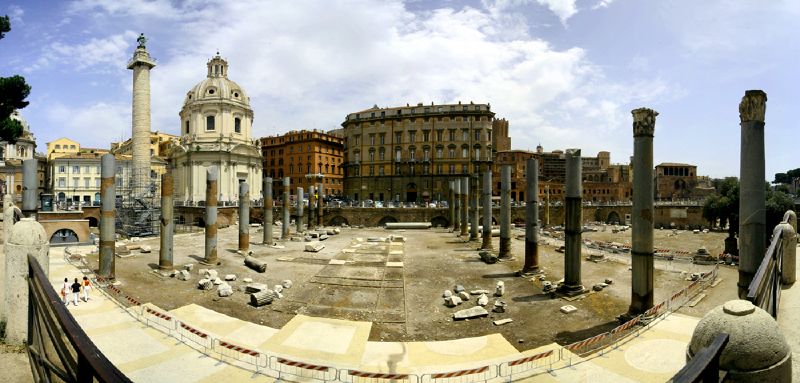
Trajan's Forum

Trajans Forum (Foro Triano) in Rome

This photo of the Trajan’s Forum is part of one of the panoramic images found on the PanoramicEarth.com Tour of Rome. There are over 100 images taken from around Rome linked to an interactive map.

Trajan’s Forum (sometimes call ‘Traiano’) lies in the centre of ancient Rome, just over the road form the Roman Forum and Colosseum. It is visited by far fewer people than the Roman Forum, but dodging traffic across the street is worthwhile. And for those concerned about road safety, the Italians have actually installed a pedestrian crossing, though whether the traffic adheres to the signals or not is a mute point.

Trajan’s Forum began life in 107 AD and is the grandest of the 5 Imperial Forums. Building it required the removal of two hill sides – the Quirinal and Capitoline (Campidoglio) Hills, which was no mean feat in a time without mechanical aid. It was intended to relieve overcrowding in the Roman Forum and to link southern Rome to the Campus Martius.

The forum was truly a masterpiece of construction became the sights of many noble acts including the releasing of slaves, burial of lists of state debtors and political prisoners, and the auction of the emperor’s personal treasures to raise money and avoid raising war taxes.

The forum measures 200m x 120m, along the far side is the Basilica Ulpia, a huge market place. Within four storeys almost anything from anywhere in the Empire was sold, wine and oil on first, spices and other imports on second, fresh fish in two ponds on fourth kept alive in ponds fed either with water from an aqueduct or sea water piped from Ostia. The third floor is thought to have contained the Congiaria, a kind of welfare office that distributed money and food to the needy.

The area owes its preservation to being converted in part to a convent, and in part to a fort. At one end stands Trajan’s Column and nearby are many important sites including the Roman Forum, Palatine Hill and Colosseum.

A full panoramic image is found on the Rome tour by PanoramicEarth.com. An enlargement of this photo can be found on Flickr.

For more articles on Rome see the Rome Index or select one of the labels at the bottom.
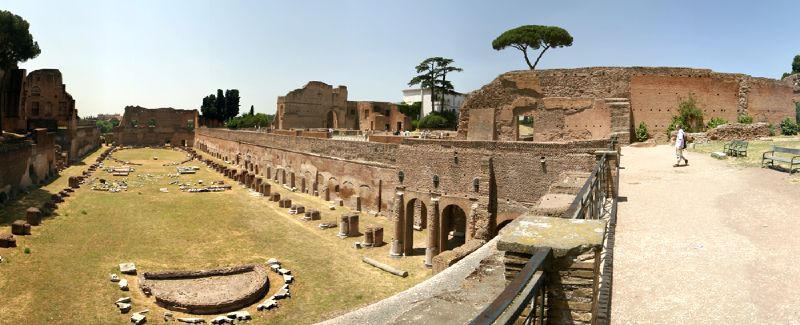
Palatine Hill - Stadium

Stadium on Palatine Hill

This view over the Stadium on Palatine Hill is part of one of the panoramic images found on the PanoramicEarth.com Tour of Rome. There are over 100 images taken from around Rome linked to an interactive map.

Full 360° panorama of the Domitian's Stadium

Palatine Hill is central, even foundational, to the history of Rome. It was here that, according to legend, Roma all began: Having been thrown over a bridge into the Tiber the twins Romulus and Remus were washed up onto the banks of the Palatine Hill and adopted by a she-wolf. The were suckled by the wolf and grew up in a cave in the hill. Later they were found and raised by a shepherd who was grazing sheep on the same hill as the wolf’s den. Remus and Romulus argued over where their city should be founded and Romulus won, killed his brother and started Rome on the Palatine Hill.

In reality the earliest archaeological findings are Iron Age huts from the 9C BC. The hill has been built up over time with one layer of buildings built upon another. The mound stands about 40m above the Roman Form and became a very desirable place to live with several Roman Emperors having palaces up here. Augustus was born here and lived in quite a modest home, which can not be said for the palaces built by Caligula, Tiberius, Nero and Domitian.

The most excavated areas on the hill include the Domus Augustana, Domus Flavia (home of Flavia, wife of Augustus), parts of Domitian’s Palace and the palace and baths of Septimius Servus.

Here you can see the Stadium, built at the same time as the Palace of Dimitian, possibly as a private garden, though it is thought that some horse racing may have occurred here. It is 160m long, well below ground level with semi-circular ends reminiscent of a hippodrome. Scattered around the Stadium are the remains of granite columns, a marble altar and various figures of gods.

Palatine Hill stands next to the Roman Forum and the Colosseum and yet, unlike the other two, it is not crawling with people even though it has some spectacular views to offer. Unlike the Roman Forum, entry to the Palatine Hill is not free, but the ticket also covers entry to the Colosseum. In fact getting your ticket to the Colosseum at the entrance to Palatine Hill can save quite a bit of time.

A full panoramic image showing the more of Domitian’s Palace is found on the Rome tour by PanoramicEarth.com. There is an enlargement of this Domitian's Stadium photo on Flickr.

For more articles on Rome see the Rome Index or select one of the labels at the bottom.
Tuesday, September 26, 2006

Arch of Constantine - Rome

Image of Arch of Constantine from Panoramic Earth Rome Tour
Arch of Constantine - Rome
Originally uploaded by ptr.watts.
The Arch of Constantine in Rome is one of the panoramic images found on the PanoramicEarth.com Tour of Rome. There are over 100 images taken from around Rome linked to an interactive map.

Full 360° panorama of the Arch of Constantine

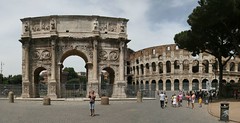
The Arch of Constantine in Rome is situated next to the Colosseum in the Piazza del Colosseo. It was erected in AD 315 by the Senate to commemorate the victory of Constantine over Maxentius at the Milvian Bridge in AD 312. While Constantine claimed his victory followed a vision of Christ prior to battle, there is nothing at all Christian in the Arch. Many components and statues, medallions and reliefs featured on the Arch of Constantine were taken from older monuments. The reliefs on the inside of the central archway and those above on the sides of the Arch come from a monument depicting the victory of Trajan over the Dacians. Similarly, there are statues of Dacian prisoners taken from Trajan’s Forum.


The eight large medallions that adorn the Arch of Constantine depict hunting scenes and pastoral sacrifices. These were taken from an unknown monument erected by Hadrian. The eight high reliefs found at the top of the Arch of Constantine, above the outer arches, were taken from a monument to Marcus Aurelius. These depict a sacrifice, speeches to the army, a triumphal entry into Rome and one of him giving bread to the poor.

In fact, the only sculptural decorations on the Arch that come from the time of Constantine are the small bas-reliefs of the frieze and the victories and captives found at the bases of the columns. Nowadays, the Arch of Constantine is often passed by quickly and without a second glace by people heading for the Colosseum or the Roman Forum.

For more articles on Rome see the Rome Index or select one of the labels at the bottom.

This article may be used freely in full providing the following acknowledgement and link is used:
Article written by Peter Watts on behalf of PanoramicEarth.com

Area Sacra Argentina - Rome


Area Sacra Argentina - Rome
Originally uploaded by ptr.watts.
The Area Sacra di Largo Argentina is one of the locations featured on the PanoramicEarth.com tour of Rome, where you will find panoramic photographs of this and other Roman locations.

Full 360° panorama of the
Area Sacra di Largo Argentina

The Area Sacra di Largo Argentina contains four temples discovered between 1926-29 when the area was being prepared for a new building. This was not uncommon in Rome and the site turned from construction to Archaeology. The temples are labeled A to D as it is not yet known who they were dedicated to. All the temples face a courtyard to the East paved with travertine.

Temple A - Area Sacra dell Argentina: Built in the later part of the 3rd Century BC. It is hexagonal and peripteral in design. Most of the columns and stylobate have been preserved. In the Middle Ages the church of St. Nicholas was built over the site. The apses are the only remains of this church and are still visible.

Temple B - Area Sacra dell Argentina: This is the most recent temple, which was circular. The remains include six columns, the original flight of steps and the alter. Behind temples B and C are the remains of a platform built of tufa blocks. These formed part of the Curia of Pompei which was rectangular and contained a statue of Pompey. It was here that the Senate met, and here that Julius Caesar was killed on March 15, 44 BC.

Temple C - Area Sacra dell Argentina: This, the oldest temple, dates from late 4th or early 3rd century BC. During the Imperial era the cella was rebuilt and the columns and podium were covered in stucco. In 1935 an altar was discovered with an inscription dating to 180 BC, though this altar was also a replacement of an earlier one.

Temple D - Area Sacra dell Argentina: Temple D is the largest temple. Part of it still lies buried under Via Florida to the south. The Torre del Papito was also excavated and preserved during this time.

The column stumps to the North behind temple A belonged to the great Hecatostylum Portico which had 100 columns. The remains of one of the two lavatories built here in Imperial times can still be seen.

More Panoramic images from Rome can be found on PanoramicEarth.com. For more articles on Rome see the Rome Index or select one of the labels at the bottom.

Monday, September 04, 2006

Roman (Magnum) Forum - Rome

Roman ForumWell, here is another one of Rome – the Roman Forum (or though it may also be known as the Forum Magnum). This ranks among the top ten visited sites in Rome, so if you go there during the high season, expect it to be crawling with tourists after about 10am when they begin to surface from the excesses of fantastic Roman food and wine the night before.

So this is the place to come to walk among 2000+ years of history. Makes you think – or would if the noise and bustle of hundreds of other people allowed you to do so. At least this is one place where you will not be contending with the crazy traffic. Though you do stand the danger of being run over by massive tour groups, so big that they can take minutes to pass by in double or even quadrouple file. So big indeed that they are communicated to via a radio earpiece link with the guide. It would appear quite possible then that those at the rear are actually looking at something the guide was talking about 5 minutes ago as they trail along at breakneck speed in order to get to the next site. That way they have ‘Done Rome’.

Oh, and if you think the crowds here are nuts – try the Coliseum, St.Peter’s or, worst of all, the Vatican Museums and Sistene Chapel, where a mile of bodies 4 deep can be found waiting to get in. Ah, but then that is Rome…

For more articles on Rome see the Rome Index or select one of the labels at the bottom.

Friday, August 04, 2006

Shooting Rome

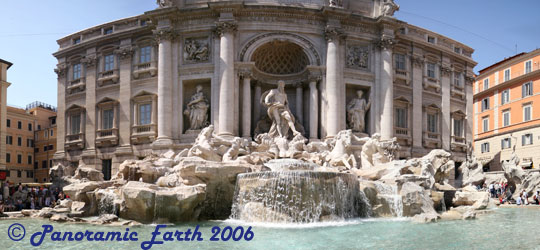
Font di Trevi - RomeRome, city of around 1000 churches. It not just feels like that when walking around, this is a fact. On almost every corner you will stumble upon another one, often heavily decorated inside. The trip to update and expand the Rome content for Panoramic Earth was completed a short while ago. We have managed to cover all the famous sites again and add a huge collection of other places. Quite a few of them are, yes, churches.

But if you want to have a wonder around the Colesseum, St.Peters, see the Font di Trevi or the Pantheon, then these will shortly be added to the Rome tour. It just takes a little while to put together over 100 panoramic photographs and then add them to the map. So please be a little more patient with us, it is coming, but we still have to eat and sleep in between times staring at a computer screen.

Some of the observations I had while there – Rome is mostly cobbled roads. These have potholes in them and are uneven to say the least. Spending 6+ hours a day on a bike cycling round the city to collect the photographs does not make you friends with your butt. Neither does working non stop for all that time in temperatures often exceeding 35º! Rome also lacks from imagination when it comes to squares, there is nothing planted out in the plazas, just expanses of black cobbles.

That aside it does have the Pantheon, Colessuem, forum, St.Peters and hundreds of other fantastic buildings. And the evenings can make up for it, the food is fantastic, and walking around the centre late at night can be quite relaxing.

New Panoramas on Panoramic Earth