Showing posts with label circus. Show all posts

Tuesday, November 14, 2006

Finsbury Circus - London

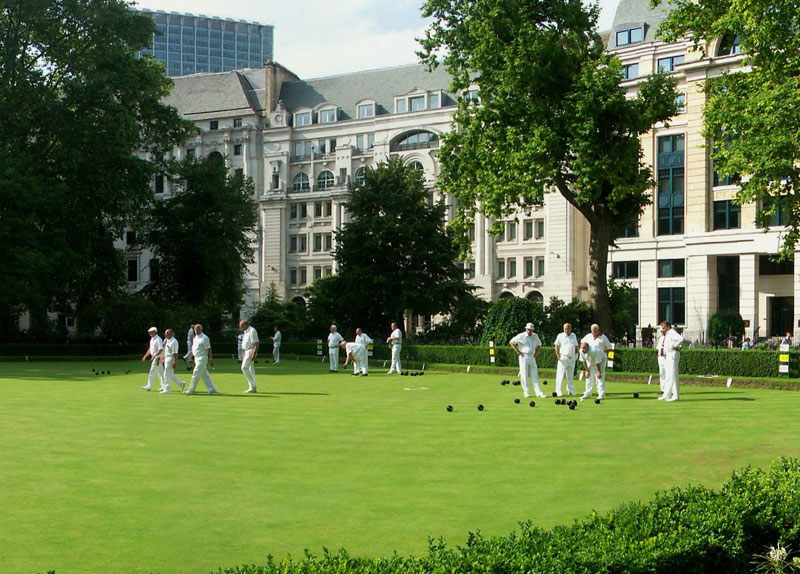
People playing bowls in Finsbury Circus in the City of London

This photo of Finsbury Circus is part of one of the panoramic images found on The London Map from Panoramic Earth. There are over 100 images taken from around London linked to an interactive map.

Plan your visit to London by taking advantage of these London Hotel Specials or Thomson City Breaks. Get the most of London with these London Guide Books

Full 360° Panorama of Finsbury Cirus

Finsbury Circus is tucked away in the near to the City of London and definitely not on the beaten track for those visiting London. It is unusual in more ways than one. Unlike many other squares in London this one is elliptical, and in the centre is an immaculate bowling green used by the City of London Bowls Club, as evidenced by the people in white shown in this picture. The nearest Tube Station is Mooregate and it is also near to the Museum of London.

Finsbury Circus is a quiet place to let time pass in the summer. Much of the square is occupied by the bowling green, but there is plenty of seating area around this and some beautiful planted areas. While this image shows the bowling green, the full panoramic image also shows the bed behind where the plantations form the crest for the City of London. Finsbury Circus also contains a band stand and it is not uncommon to hear live jazz or other music drifting across the square in the summer.

The history of Finsbury Gardens goes back a long way, to Roman times, when the area, known as ‘Fesnbury’ and effectively a moor. In the early 15C the city wall was breached at this point and nearby Moorgate was completed. By the early 17C the area had been raised and planted with trees becoming a public park, the first in London, in 1606. The land of Finsbury Circus was acquired by the Corporation of London in 1900 and the bowling green laid in 1904.

None of the buildings around Finsbury Circus are original (William Montegue built some fine houses here around 1815), but those that do now surround the oval square are graceful curved terraces typically occupied by banks, insurance companies and the like. The HQ of British Petroleum is also currently located on Finsbury Circus.

An enlargement of this photo can be found on Flickr.

For more articles on London see the London Index or select one of the labels at the bottom.

Tuesday, October 24, 2006

Piccadilly Circus and Eros - London

Statue of Eros (or Angel of Christian Charity) in Piccadilly Circus, London

This photo of the Piccadilly Circus in London is part of one of the panoramic images found on the PanoramicEarth.com Tour of London. There are over 100 images taken from around London linked to an interactive map.

Plan your visit to London by taking advantage of these London Hotel Specials or Thomson City Breaks.

‘It’s like Piccadilly Circus in here!’ Ever heard the phrase? Well, Piccadilly Circus is in the very heart of the West End of London. There are 8 lanes of traffic feeding into the poor circus which, having been installed in the time of horse and cart, is naturally struggling to cope. The area has a long history, going back to around 1620. The road from here, Piccadilly, connected to Pickadilly Hall, which house a merchant famous for is collars, or piccadills. In 1819 Regent Street was being built by John Nash and the meeting point of the two was called Piccadilly Circus.

Apart from the traffic the area is noted for several other things. First it is the name of the local underground station (opened 1906), which, with numerous access points around the square, sits directly beneath it disgorging visitors by the elevator load continuously. The square is surrounded by shops, theatres and arcades making it a very popular location. On the corner of Regent Street and Shaftesbury Avenue the buildings are plastered with enormous neon advertising continuously enthusing the delights of fast food and fizzy drinks. Thankfully this mode of advertising has not been permitted to spread beyond into the rest of London.

In the south, pedestrianised side of Piccadilly Circus stands a statue built in memorial to an Anthony Ashley Cooper, 7th Earl of Shaftesbury, who was well known Christian with a keen concern for social justice. Among his achievements were the promotion of several acts forcing the improvement of working conditions, and the welfare and education of children (he formed the Ragged Schools which provided education for at least 300,000 children in London alone between 1840 and 1881.

Ironically Westminster decided to build, in honour of this Christian reformer, a statue to a Greek god of 'mature love' Anteros, brother of Eros. It was renamed the Angel of Christian Charity after some comment, but the name never caught on, and then became known as Eros, thus seeming to celebrate the surrounding entertainment and red light areas of the West End and Soho. The statue is one of the icons of London.

Over 200 Destinations with HotelConnect

The image here shows the statue and fountain of Eros. The famous advertising hoardings are off to the left. The road just to the right of the statue leads to Leicester Square. The full panoramic image can be found on the London tour by PanoramicEarth.com. An enlargement of this photo can be found on Flickr.

For more articles on London see the London Index or select one of the labels at the bottom.
Friday, October 13, 2006

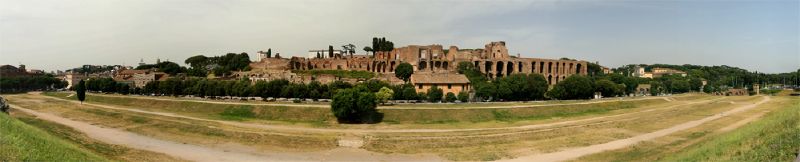
Circus Maximus - Rome

Circus Maximus - Rome

This photo of the Circus Maximus is part of one of the panoramic images found on the PanoramicEarth.com Tour of Rome. There are over 100 images taken from around Rome linked to an interactive map.

Full 360° panorama of the Circus Maximus

Unfortunately there is very little remaining of the Circus Maximus in Rome, very well known as the location of the chariot race in Ben Hur. It was far too convenient to plunder the building materials for other projects so this is now an open area used for walking dogs. It is a pitiful end to an arena which in it’s day could seat around 300,000 people, with almost the same number viewing from the surrounding hills.

There is evidence to suggest that the area of the Circus Maximus was first used by the Etruscan kings as a place for games as far back as 600 BC. It continued to be associated with public events and in 50 BC Julius Caesar expanded the arena. In 81, the Senate built a triple arch honoring Titus by the closed East end (not to be confused with the Arch of Titus on the opposite side of the Palatinum Hill near to the Colosseum and Roman Forum).

This was made for chariot racing, the track is about 600m long and 80m wide and could hold 12 chariots at a go. The two sides of the track were separated by a spina (spine) that ran down the center. At each end was a meta, a turning post the chariots would career round at dangerous speeds. The number of laps was marked by rotatable metal dolphins set along the top of the spina. The spina also supported various statues and Augustus placed an obelisk here (moved to Piazza del Popolo by pope Sixtus in 16C).

It is hard to imagine the chaos and confusion that must have resulted during the race, and the best depiction is probably still the chariot race in Ben Hur. Only one of the 12 chariots would survive the race, the others crashing at some point throughout. There was a dedicated crew whose only job was to remove the remains of ruined chariots and the dead and injured people and animals from the track without becoming track-kill themselves.

This image is taken from the lookout on the Via del Circo Massimo. Behind the Circus Maximus you can see the Palatine Hill and the ruins of Domitian’s Palace. Further panoramas from Rome are on PanoramicEarth.com. An enlargement of this photo can be found on Flickr.

For more articles on Rome see the Rome Index or select one of the labels at the bottom.

New Panoramas on Panoramic Earth