Showing posts with label building. Show all posts

Wednesday, November 01, 2006

Royal Courts of Justice (Law Courts) - London

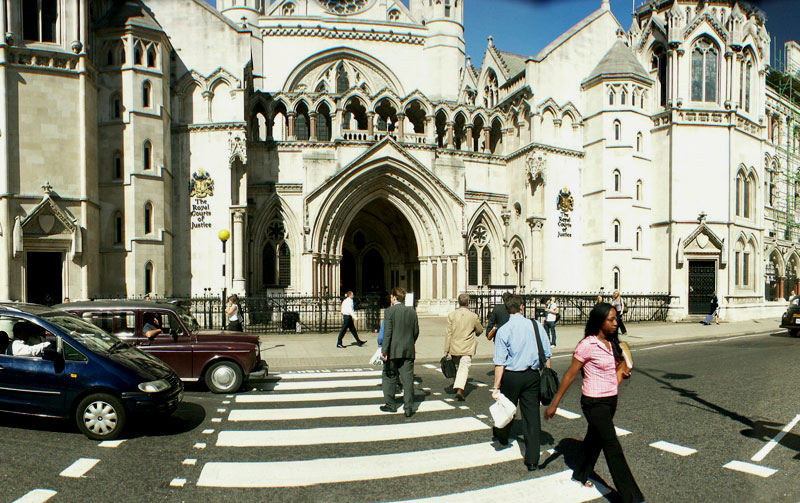
Royal Courts Of Justice (also called The Law Courts) in London

This photo of the Royal Courts of Justice in London is part of one of the panoramic images found on the PanoramicEarth.com Tour of London. There are over 100 images taken from around London linked to an interactive map.

Plan your visit to London by taking advantage of these London Hotel Specials or Thomson City Breaks.

The Royal Courts of Justice stand on the Strand, just to the east of Aldwych. The strand is horribly busy most of the time, and getting a clear shot of the front of the building involves waiting for traffic to be stopped by people crossing the road. And stop they do, for surely running someone over on the pedestrian crossing outside the Royal Courts of Justice would have to be problematic in the extreme.

The Royal Courts of Justice are more commonly known as the Law Courts, and handle civil trials in the country. There are some 88 court rooms contained within the huge Gothic building, all of which the public are allowed to enter as long as the courts are in open session and neither the judge is giving out sentence, nor witnesses being sworn in. A list stating the progress of each case is found in the central hall.

The Royal Courts of Justice also contain a small collection of legal attire, which the visitor may view, and a guided tour of the building runs twice a month. This is an excellent way to find out more about the building. For those interested there is also a Guide to the Royal Courts of Justice available.

The Royal Courts of Justice were designed by George Edmund Street and opened by Queen Victoria in 1882, it is the last major Gothic revival building to be erected in London, using of some 35 million bricks faced with Portland stone, containing 1,000 rooms and 3.5 miles of corridors. Previously to this the site contained 450 houses which were demolished to provide the land required.

When you enter the Law Courts from the Strand you will pass under two elaborately carved porches which are fitted with iron gates. The carvings on the outer porch show the heads of the most eminent lawyers of the time, with the Saviour represented at the highest point. Over the Judges (north) entrance are carvings of both cats and dogs, representative of the legal forces and litigants fighting it out in court (but in a genteel clashing of words, of course).

The whole area is, naturally, peppered with the most famous, and therefore often the most expensive, of solicitor firms in the UK. Near to the Royal Courts of Justice you will find the esteemed institutions of The Temple, and Lincolns Inn. The nearest tube stations are Waterloo, just across the Thames at Waterloo Station, and Charring Cross, at the Western end of the Strand.

Over 200 Destinations with HotelConnect

The full panoramic image of The Royla Courts of Justice can be found on the London tour by PanoramicEarth.com. An enlargement of this photo can be found on Flickr.

For more articles on London see the London Index or select one of the labels at the bottom.

Tuesday, October 31, 2006

London City Hall (GLA Headquaters)

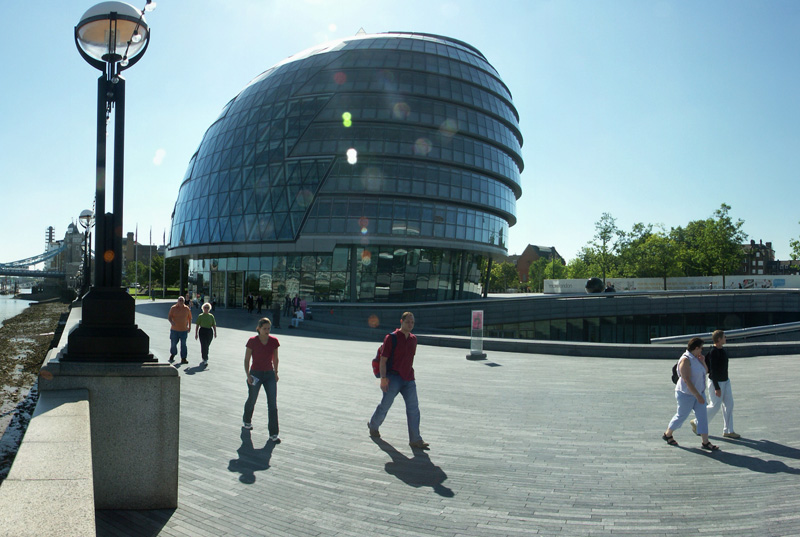
City Hall GLA Headquaters

This photo of the City Hall in London is part of one of the panoramic images found on the PanoramicEarth.com Tour of London. There are over 100 images taken from around London linked to an interactive map.

Plan your visit to London by taking advantage of these London Hotel Specials or Thomson City Breaks. Get the most of London with these London Guide Books

City Hall is the home of the Greater London Authority, and is a new building on the Thames situated between London Bridge and Tower Bridge, just a little way down from HMS Belfast. The striking rounded glass building was opened in 2002 and has a very unusual shape, intended in part to increase energy efficiency as well as to provide a striking landmark.

It has been compared to Darth Vader's helmet, a misshapen egg, a woodlouse or a motorcycle helmet. The first occupant, London Mayor Ken Livingstone, must have surely come up with the best one, calling it a "glass testicle". Given the taxes imposed on Londoners during his internship, many may be inclined to go with the Vader Helmet analogy. In fact the building does not belong to the GLA, but is rented on a 25 year lease (at an annual cost of £36.50 per square foot). Next to the City Hall is The Scoop, a sunken oval area used for outdoor displays during the summer.

The interior of City Hall is designed around a magnificent interior ramp down which the people can walk above the debating chamber. It is a 42m high, 10 storey building. Every one of the 3,844 glass panels that make up City Hall is unique and was cut by laser. Norman Foster, one of the principal architects, had previously used the ramp concept in Berlin's Reichstagsgebäude. (Again in a possible farce, this ramp has been likened to that in the penguin enclosure of London Zoo.). The top storey, referred to as 'London's living room', leads out onto a balcony with a 360˚ panoramic view of the city.

The following books on London architecture may be of interest to you:
London's Waterfront: The Thames from Battersea to the Barrier
New London Architecture
London: A Guide to Recent Architecture

City Hall is open to the public, the Greater London Authority website has visiting details. Other attractions near to City Hall include The Monument, Winston Churchill’s Britain at War, Vinopolis, Southwark Cathedral, Tower of London and Tower Bridge and HMS Belfast. Entrance to all of these London attractions is free to holders of the London Pass. Other nearby attractions include The London Dungeon, Hay’s Galleria (for shopping) and the Design Museum.

The nearest stations to London City Hall are London Bridge and Tower Hill.

Over 200 Destinations with HotelConnect

The full panoramic image of City Hall can be found on the London tour by PanoramicEarth.com. An enlargement of this photo can be found on Flickr.

For more articles on London see the London Index or select one of the labels at the bottom.

Wednesday, October 25, 2006

Admiralty Arch - London

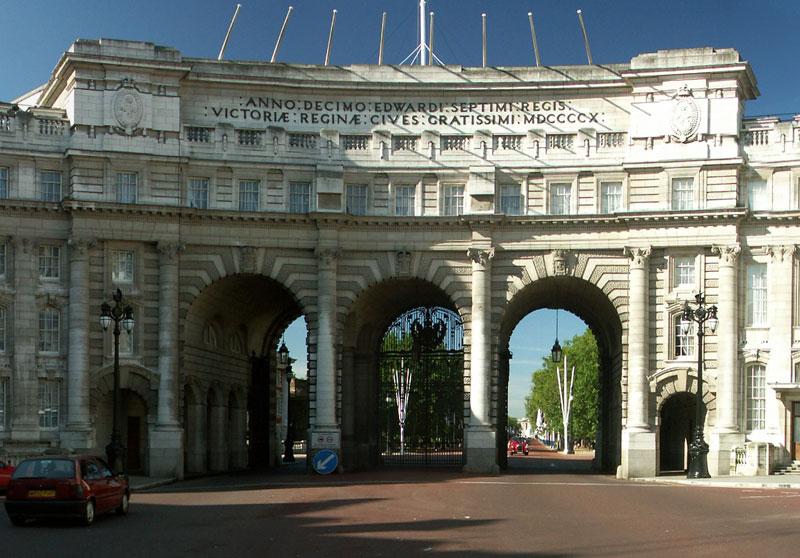
Admiralty Arch in the corner of Trafalgar Square leading onto the Mall, London.

This photo up the Admiralty Arch in London is part of one of the panoramic images found on the PanoramicEarth.com Tour of London. There are over 100 images taken from around London linked to an interactive map.

Plan your visit to London by taking advatage of these London Hotel Specials or Thomson City Breaks.

Admiralty Arch has actually no connection with the navy, except that it is adjoins the Royal Navy HQ located in the Old Admiralty Building. However, the name continues the naval theme of Trafalgar Square on whose southwest corner the arch is located.

Admiralty Arch forms a gateway from Trafalgar Square to The Mall, the processional road running along St. James Park and linking Buckingham Palace to Horse Guards Parade. There is always a lot of traffic passing through Admiralty Arch, except on a Sunday when traffic is not permitted down most of The Mall.

Admiralty Arch is quite a new building being commissioned by King Edward VII in 1910 in memory of his mother Queen Victoria. Edward did not live to see the project completed. It was designed by Sir Aston Webb (also worked on Buckingham Palace and the Victoria and Albert Museum) who also widened the Mall at the same time and provided the gilt statue of Victoria at the far end of the Mall just in front of the Palace.

Admiralty Arch has 5 arches and is faced with Portland Stone. Just below the top of the building is an inscription which reads: ANNO DECIMO EDWARDI SEPTIMI REGIS VICTORIÆ REGINÆ CIVES GRATISSIMI MDCCCCX (translates to : "In the tenth year of the reign of King Edward VII, to Queen Victoria from a grateful nation, 1910"). The 2 smaller outer arches are for pedestrians only, and the central large arch is only ever used for processional purposes. Thus Admiralty Arch presents the largest processional arch between Buckingham Palace and St. Paul’s Cathedral.

In July 2006 Greenpeace scaled Admiralty Arch and suspended banners accusing the British Government of “trashing rainforests” by using unsustainable timber during renovation of the Cabinet Offices within. Apart from closing the Mall to traffic for a couple of hours, nothing much more happened and the protest ended peacefully. Nelson’s Column in Trafalgar Square has also been used as a high profile protest point by Greenpeace in the past.

The nearest tube stations to this point are Leicester Square and Charring Cross stations.

Over 200 Destinations with HotelConnect

The full panoramic image showing more of more of the surrounding buildings and Trafalgar Square can be found on the London tour by PanoramicEarth.com. An enlargement of this photo can be found on Flickr.

For more articles on London see the London Index or select one of the labels at the bottom.
New Panoramas on Panoramic Earth