Showing posts with label albert. Show all posts

Wednesday, October 25, 2006

Albert Memorial - London

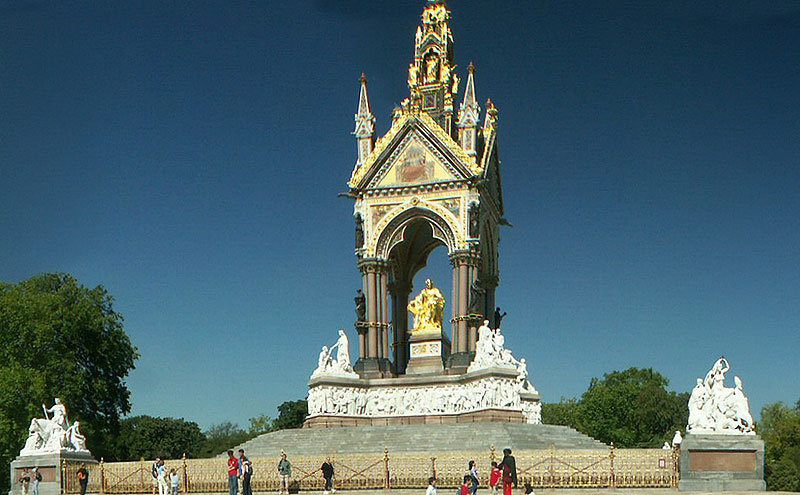
Albert Memorial in Hyde Park in London, opposite the Royal Albert Hall.

This photo up the Albert Memorial in London is part of one of the panoramic images found on the PanoramicEarth.com Tour of London. There are over 100 images taken from around London linked to an interactive map.

Plan your visit to London by taking advatage of these London Hotel Specials or Thomson City Breaks.

The Albert Memorial is located in Kensington Gardens in Hyde Park, just opposite the Royal Albert Hall. These, like the Victoria and Albert Museum, were built by Queen Victoria in memory of her consort Albert who died of typhoid in 1861. This memorial is also a memorial to the Victorian era, mindset and powerbase at the time as it is packed with allegory. This end of the park is far less visited than the area around Hyde Park Corner, which means that at least you will have the time to explore it fully.

‘Explore’ does not mean that you are able to clamber upon it, but there are so many facets to the memorial that it deserves some time. The Albert Memorial opened in 1872 and is designed in Gothic Revival fashion with a large figure of Prince Albert seated ceremonially at the centre of the ornate canopy, holding a catalogue of the Great Exhibition of 1851. Above Albert's head are allegorical figures of Agriculture, Manufacture, Engineering, and Commerce. Representations of the morals of the Victorian era continue up the pinnacle including Faith, Hope, Charity, and Humility nearest the top. The whole is about 175 feet high.

The Albert Memorial is surrounded by four flights of steps leading up to the pavilion, and at the corners of each of these groups of statues represent the four continents of Europe, Africa, Asia and the Americas. The pavilion base is surrounded by the Frieze of Parnassus, an elaborate composition showing 169 individual architects, composers, painters, poets, and sculptors, thus celebrating the Victorian Arts.

Four grey granite pillars support the canopy. Each one is cut from a single stone gray granite from Castle Wellan Quarries, Northern Ireland, weighs about 17 tons and took 8 men 20 weeks to polish. Surrounding these are red granite pillars from Ross of Mull. The capitals are of Darley Dale stone and the Arches made from Portland Stone. Albert is seated on a pedestal made of pink granite and marble.

During WWI the Albert Memorial was painted black but restoration has seen all the splendour and colour restored, Albert is now covered in gold leaf.

Over 200 Destinations with HotelConnect

The full panoramic image showing Hyde Park and the view over to the Royal Albert Hall can be found on the London tour by PanoramicEarth.com. An enlargement of this photo can be found on Flickr.

For more articles on London see the London Index or select one of the labels at the bottom.

Tuesday, October 24, 2006

Victoria and Albert (V&A) Museum - London

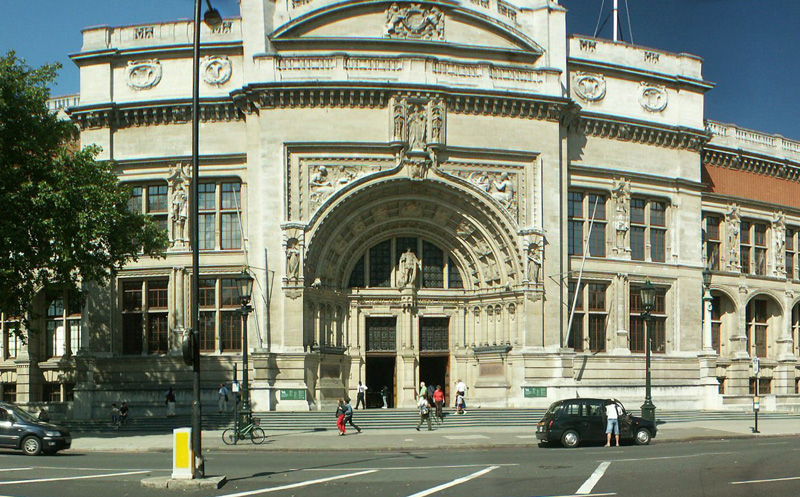
Victoria and Albert Museum (V&A Museum) in London

This photo of the Victoria and Albert (V&A) Museum in London is part of one of the panoramic images found on the PanoramicEarth.com Tour of London. There are over 100 images taken from around London linked to an interactive map.

Plan your visit to London by taking advantage of these London Hotel Specials or Thomson City Breaks.

The Victoria and Albert Museum (often called the V&A) was established in 1852 as the Museum of Manufacturers following the success of the Great Exhibition of 1851. The aim was to use the profits from the Great Exhibition to form a collection of items from around the world that would make art available to all and inspire British designers and manufacturers. In 1872 the collection was moved to the present site, then called the South Kensington Museum, and in 1899 it was renamed ‘Victoria and Albert’ Museum in honour of Queen Victoria and her consort Albert (Albert also has a hall and memorial just up the Exhibition Road in Hyde Park named after him) when the Queen laid the foundation stone of a new building to house the growing collection at the same site.

Thus the origins, what about the collection? The V&A collection now spans 2000 years of art from almost every culture and in almost every medium. Right from the outset the museum set out to acquire the very best of art available in every medium from glass work to metal work. As the market was far less competitive, it was able to fulfill these aims admirably to present the world with the outstanding collection we have today. There is also a particular emphasis on the development of British art throughout the centuries.

The V&A is on the corned of Cromwell Road and Exhibition Road and forms a cluster of museums along with the Natural History Museum (with the Earth Galleries) and the Science Museum. Once you have indulged the delights within the V&A’s 154 galleries, and explored the artifacts from Japan, India or the Orient, the local area around South Kensington and Knightsbridge offer many places to find refreshments.

The Victoria and Albert Museum is on the corner of Cromwell Gardens and Exhibition Road in South Kensington, west London. Entrance to the Museum itself is free.

Over 200 Destinations with HotelConnect

The image here shows part of the front of the V&A with the main entrance on Cromwell Road. Inside the entrance hall, at the focal point of the rotunda, is suspended a 9m high chandelier made of blown glass, typifying the museum’s raison d’ être. The full panoramic image can be found on the London tour by PanoramicEarth.com. An enlargement of this photo can be found on Flickr.

For more articles on London see the London Index or select one of the labels at the bottom.

New Panoramas on Panoramic Earth