Showing posts with label vatican. Show all posts

Wednesday, February 09, 2011

Beautiful Panorama of Rome

Just one of the many dramatic 360° panoramic views and virtual tours of Rome. This one was created from a series of images taken on a sunny day while walking around the Cupola of St Peters Basilica in the Vatican. It provides a dramatic 360 view of the Roman skyline.


See the complete virtual tour of Rome, featuring pictures and information from many of the most important and popular landmarks and tourist attractions around the city, or search out your favourite place on the Rome panorama index.

Travelling to Rome? Check out these cheap Rome hotel deals.

Friday, October 06, 2006

Ponte Vittorio Emanuele

Ponte Vittorio Emmanuele in Rome

This image from Ponte Vottorio Emanuele II is part of one of the panoramic images found on the PanoramicEarth.com Tour of Rome. There are over 100 images taken from around Rome linked to an interactive map.

Full 360° panorama of the Vittorio Emanuele II bridge

The Vittorio Emanuele II bridge is a modern construction and is usually full of cars. It makes for the most direct link from the centre of Rome to the Vatican effectively joining the Corso Vottorio Emanuele with the Via De Conciliazione which then leads straight up to St. Peter’s Basilica. From here you can see up the river to the Ponte S Angelo and the Castel S Angelo, which are both in the background.

The Vittorio Emanuele II bridge was designed by Ennio De Rossi and opened on 5 June 1911, taking 25 years to build. The bridge has 3 arches and is 111m long and 20m wide. An 18th century building belonged to the Hospital Saint Spirit was destroyed during construction. It is a good example of the architecture of the time having four heavy allegorical sculptures situated over the central arch and four end pillars decorated with bronze Victories. The marble sculptures represent Liberty, Oppression defeated, Unity of Italy, and Loyalty to the Constitution.

The full panoramic image showing views both up- and down-river is found on the Rome tour by PanoramicEarth.com.. For better appreciation of this image go to the collection on Flickr.

For more articles on Rome see the Rome Index or select one of the labels at the bottom.

Friday, September 29, 2006

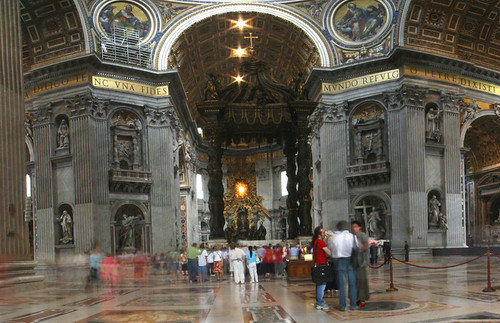
St Peter's Basilica Rome - The Papal Altar

This image of the Papal Alter in St. Peter's Basilica in Rome ispart of one of the panoramic images found on the PanoramicEarth.com Tour of Rome. There are over 100 images taken from around Rome linked to an interactive map.

Full 360° panorama of the Basilica of Saint Peter

The Basilica of Saint Peter is officially known in Italian as the Basilica di San Pietro in Vaticano and colloquially called Saint Peter's Basilica. It is the focal point of the Vatican. St Peter’s Basilica has been through many changes over the centuries. The first St. Peter’s was built by Constantine between 320-322 AD. Over the following centuries the site endured several lootings and further embellishments. By the 1500 St. Peter’s had suffered from neglect, was irreparable and dismantled to make room for the current Basilica. Thus on April 18, 1506, the cornerstone to the current version of St. Peter’s Basilica was laid by Pope Julius II. Work continued for over 100 years to produce the current form.

Extensive information about the Basilica can be found on stpetersbasilica.org. The interior of St. Peter’s Basilica is a museum in it’s own right. There are over 400 statues on display aside from other paintings and artifacts. In addition to this the Basilica is large enough to house over 40 chapels. Entrance is via one of 5 named doors of the portico, each of which has a distinct history. The central door is from the old St. Peter’s Basilica. St. Peter’s Basilica is laid out in the form of a Latin Cross, the main nave is 40m high and the floor laid in intricate marble patterns.

The central focus is the Papal Altar, where only the pope celebrates Mass. The baldachin rising over the central altar was designed by Bernini. It is made of 37 tonnes of bronze, stands some 30 meters high, built to fill the space beneath the dome soaring about 140m above it. The bronze used was taken from the Pantheon. Underneath this baldachin is the traditional tomb of St. Peter.

Surrounding the 4 corners of this canopy are 4 pillars which support the weight of the dome. Each of these is 71m in circumference. Each contains a huge statue 4 saints whose relics are preserved in chapels set above the statues part way up the columns. These are the saints Helena, Veronica, Andrew and Longinus (who is said to be the soldier who pierced Jesus whilst he hung on the cross). At the tops of the columns a Latin inscription runs around the base of the arches. Above this are 4 mosaics.

As can be seen in this picture, the whole environment dwarfs those attending it. There are more panoramas from Rome on Panoramic Earth. There is an enlargement of this image of St. Peter's on Flickr.

For more articles on Rome see the Rome Index or select one of the labels at the bottom.

Rome Articles Index

Below is listed an index of the articles posted about Rome. Each represents a place in Rome that was photographed for the Rome Tour on PanoramicEarth.com, where you will find panoramic images of Rome linked to an interactive map. This list of Roman articles will continue to grow.

St. Peter's Bascilica and the Vatican
St. Peter's Basilica in the Vatican - Facade
St. Peter's Basilica - The Papal Altar
St. Peter's Piazza (Square) in the Vatican
View from Cupola of St. Peter's Basilica over St. Peter's Square

Museums of Rome
Castel Sant Angelo
Galleria Colonna and Palazzo Colonna
Galleria Nazionale d'Art Moderna

Ancient Rome

Arch of Constantine
Arch of Titus
Area Sacra Argentina
Basilica of Julia - Roman Forum
Circus Maximus
Colosseum - Inside
Colosseum - Outside
Column of Marcus Aurelius
Palatine Hill - Stadium
Pantheon
Porta Maggiore and Aqueduct
Pyramid of Gaius Cestius
Roman Forum (Magnum Forum)
Temple of Antonius and Faustina - Roman Forum
Temple of Romulus - Roman Forum
Trajan's Forum

Churches in Rome dedicated to Mary / Maria
S Maria ad Martyres
S Maria delgi Angeli
S Maria della Consolazione
S Maria Maggiore Basilica
S Maria dei Miracoli
S Maria in Monterone
S Maria del Popolo
S Maria in Trastevere
S Maria della Vittoria
SS Nome di Maria al Foro Triano

Other Churches in Rome
Chiesa di Santa Maria in Palmis
Domine Quo Vadis
Il Gesu
S Ambrogio e Carlo
S Bartolomeo all'Isola
S Bernardo alle Terme
S Bonifacio e Alessio
San Carlo alle Quattro Fontane (San Carlino)
S Clemente in Laterano
S Croce in Gerusalemme
S Eugenio
S Giovanni in Laterano
S Lorenzo in Miranda
St Paul within the Walls
S Sussanna

Fountains,
Fountain of Neptune - Piazza Navona
Fontanone dell'Acqua Paola
Fountain of Roma between the Tiber and Anio - Piazza del Popolo
Fontana dei Quattro Fiumi -Piazza Navona
Fontana di Trevi (Trevi Fountain)

Piazzas and OtherSights in Rome

Piazza Colonna
Piazza Navona
Piazza del Popolo
Piazza della Repubblica
Piazza di Spagna and Barcaccia Fountain
Ponte Palatino and Ponte Rotto
Ponte Vittoria Emanuele

This tour is available for other sites to use for free and works as an i-frame with the page code. I have embedded the tour within this blog.

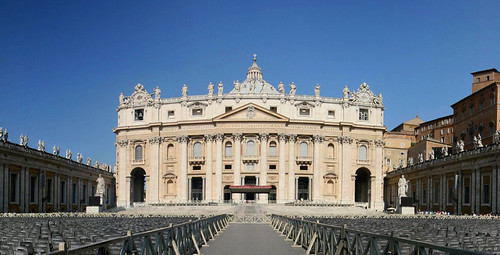
St. Peters Basilica - Rome. The Facade

This image of the front of St. Peter's Basilica in Rome ispart of one of the panoramic images found on the PanoramicEarth.com Tour of Rome. There are over 100 images taken from around Rome linked to an interactive map.

Full 360° panorama of the view from the front of St. Peter's Bascilica.

The Basilica of Saint Peter is officially known in Italian as the Basilica di San Pietro in Vaticano and colloquially called Saint Peter's Basilica. It is the focal point of the Vatican. St Peter’s Basilica has been through many changes over the centuries. Just over 500 years ago, on April 18, 1506, the cornerstone to the current version of St. Peter’s Basilica was laid by Pope Julius II. At the beginning of the first Century AD the area was the gardens of Agrippina. Caius Caligula built a circus here and the obelisk in the centre of St. Peter’s Square was erected near to it’s current position at this time.

Work on the current façade of St.Peter’s began on February 10, 1608, taking until 1612 to complete. The ornamentation took another 2 years to install. The 1m high inscription that runs above the main columns states: "Paul V Borghese, Roman, Pontiff, in the year 1612, the seventh of his pontificate, [erected] in honour of the Prince of Apostles". The central balcony, the Loggia of the Blessings, is the site from which a new pope is announced, and from where the pope gives the Urbi et Orbi blessing. The façade of St. Peter’s is 118m wide and 48m tall.

The front of St. Peter’s is hugely impressive, people seem dwarfed by the façade. Along the top are 13 massive travertine statues of Christ, other gospel characters. These are, from left to right – Thaddeus, Matthew (gospel writer), Philip, Thomas, James, John the Baptist, Jesus Christ (central figure with a cross), Andrew, John the Evangelist (gospel writer), James the younger, Bartholomew, Simon and Matthias. Peter is represented in a relief under the Loggia of the Blessings with Christ.

Currently visitors to St. Peter’s Basilica ascend a series of steps from the far right of the façade having passed through security and walking past a huge 5.5m tall statue of St. Paul placed upon a pedestal almost 5m high. Entrance to the Basilica itself is through the main doors in the centre of the façade. Those wishing to visit the tombs of the popes or ascend to the Capula of Ct. Peter’s must pass to the right of the façade. Those leaving the tour of the tombs pass out along the left of the façade where the Swiss Guards are stationed at the Arch of Bells Entrance. Above this arch are the bells of St. Peter’s, the larges of which is 2.5m in diameter.

There is an enlargement of this picture of the facade of St. Peter's Basilica on Flickr. Panoramic Earth also has panoramas from St. Peter's Square and inside St. Peter's Basilica with more information.

A very good map of the area with further information is found on St.PetersBasilica.org Square and Area pages.

For more articles on Rome see the Rome Index or select one of the labels at the bottom.

Thursday, September 28, 2006

Saint Peter's Piazza - Rome


Piazza S Pietro

St. Peter's Square in Rome is one of the panoramic images found on the PanoramicEarth.com Tour of Rome. There are over 100 images taken from around Rome linked to an interactive map.

Full 360° panorama of Saint Peter's Square (Piazza San Pietro)

Saint Peter's Square (Piazza San Pietro) is also known as Saint Peter's Piazza. It is the open space directly in front of St. Peter’s Basilica in the Vatican City. It is here that a congregation gathers every Wednesday morning to hear a Papal address, and also to see the Pope from the balcony of the Papal residence to the right of the piazza. The dimensions of St. Peter’s Square are almost identical to those of the inside of the Colosseum. It is estimated that 300,000 people could easily gather here without crowding.

Design of St. Peter's Square:
St. Peter’s Square was redesigned by Gian Lorenzo Bernini under the rule of Pope Alexander VI between 1656 to 1667. The piazza is partially surrounded by two curved, covered colonnades, each of which contains 4 rows of a total of 284 Doric style columns. On top of each colonnade are statues of 96 saints and martyrs. At the centre of the Piazza is a 25.5m tall red granite obelisk which dates from the 13th Century BC. It had originally been brought to Rome from Egypt in 35 AD by Emperor Caligula and was moved to the current site in 1586 by the engineer Domenico Fontana under the direction of Pope Sixtus V. The task took 900 men, 150 horses and 47 purpose-built cranes to complete. On the top of the obelisk was a guilt ball that was thought to contain the ashes of Julius Caesar. This was removed a replaced with an iron cross.

At the focal point of each of the colonnades are spectacular 2 fountains which were placed here in 1614 and 1667. Between the obelisk and each fountain is a small round porphyry slab. Viewing the colonnades from these positions gives you the illusion that there is only one row of columns. The paving of the square is broken up by lines of travertine radiating from the centre. Around the obelisk are the markings of a compass. In 1817 circular stones were set to mark the tip of the obelisk at noon as the sun entered each of the signs of the zodiac, making of the obelisk a gigantic sundial's gnomon.

From the far end of the Piazza three flights of steps ascend to the entrance of St Peter’s Basilica, the focal point of the temporal jurisdiction of the Roman Catholic Church.

There are more panoramas from the Vatican on Panoramic Earth. The larger version of this image is available on Flickr.

For more articles on Rome see the Rome Index or select one of the labels at the bottom.

New Panoramas on Panoramic Earth