Showing posts with label fountain. Show all posts

Friday, December 08, 2006

Italian Gardens in Kensington Gardens, London

 Italian Gardens Fountains in Kensington Gardens

This photo of the view of The Italian Gardens in Hyde Park, London is part of one of the panoramic images found on the PanoramicEarth.com Tour of London. There are over 100 images taken from around London linked to an interactive map.

Plan your visit to London by taking advantage of these London Hotel Specials or Thomson City Breaks. Get the most of London with these London Guide Books

The Italian Gardens in Kensington Gardens are the result of nearly 200 years of activity by the kings and queens of England in Hyde Park. The Italian Gardens are on the north edge of the park, just inside Lancaster Gate, at the top of Long Water and just to the west of West Carriage Drive. At the other end of Kensington Gardens you will find the Albert Memorial and the Serpentine Gallery.

The Italian Gardens contain 4 fountains set in octagonal ponds set around one smaller central fountain, also set in an octagonal pond. At the north end there is a shelter which used to be the steam powered pump house that provided water for the Long Water. This is decorated with 3 heads above each arch, one central male face flanked by female faces. The edge of the fountain area is lined by stone urns with dolphins and yet more ideal heads, and at the south end of the Italian Gardens the water cascades down a sculpture of water nymphs by John Thomas into the Long Water.

Half way down the eastern edge of the Italian Gardens is a statue to Dr. Edward Jenner who perfected the smallpox vaccine in 1796 and provided the world with the first steps towards the eradication of this virus which had plagued humans for thousands of years. The statue used to be in Trafalgar Square.

Back in 12C Hyde Park belonged to a manor used by monks. It was seized by Henry VIII and turned into a Royal Hunting Ground around 1530. In 1637 the park was opened to the public then in the late 17C King William and Queen Mary brought Nottingham House and renamed it Kensington Palace.

We owe many of the modern features of the Kensington Gardens to Queen Caroline in the 18C who, being a keen gardener, took almost 300 acres from Hyde Park and turned them into Kensington Gardens to go with Kensington Palace. She separated it from Hyde Park by a ha-ha and created the Serpentine by damning Westbourne Stream. Queen Victoria commissioned the Italian Gardens at the same time as the Albert Memorial

There are many other famous monuments around Kensington Gardens and Hyde Park including the Albert Memorial, Diana Memorial Fountain, Marble Arch, Wellington Arch and numerous other statues.

Over 200 Destinations with HotelConnect.

The nearest Tube station to the Italian Gardens is Lancaster Gate.

The full panoramic image taken from the Italian Gardens can be found on the London tour by PanoramicEarth.com. An enlargement of this photo can be found on Flickr. You can also find a marker for the Italian Gardens on Tagzania.

For more articles on London see the London Index or select one of the labels at the bottom.

Friday, November 03, 2006

Diana Memorial Fountain - Hyde Park

Diana Memorial Fountain, by Peter Watts

This photo of The Diana Memorial Fountain in London is part of one of the panoramic images found on the PanoramicEarth.com Tour of London. There are over 100 images taken from around London linked to an interactive map.

Plan your visit to London by taking advantage of these London Hotel Specials or Thomson City Breaks. Get the most of London with these London Guide Books

Princess Diana died in 1997, an event which shocked Britain and the world. The Princess of Wales had a place in the hearts of the nations like no other British Royal. This was clearly demonstrated by the 6 million or so visitors how came to London for the funeral of Princess Diana. After much debate and not a little controversy, this unique Memorial to Diana, Princess of Wales was opened by Her Majesty The Queen on 6th July 2004.

The Diana Memorial Fountain is found in Hyde Park just on the south side of the Serpentine Bridge, next to the Lido. In fact the Diana Fountain is more like a stream than a fountain, there are no sprays of water, no statue, nothing above ground level. The fountain is a large stepped oval trench made of 545 pieces of Cornish Granite set into the ground at an incline. Some 50 wide and 80m long this forms 2 channels that vary from 3m to 6m wide, through which water runs and bubbles to a pool at the bottom of the oval before draining away.

The Diana Memorial Fountain also has three bridges crossing the water ways allowing visitors access to the centre of the grassed oval. In the summer the Diana Fountain is popular with tourists who come and relax amidst the sound of bubbling water.

It was intended that the Diana Memorial Fountain would be child friendly, the granite was left with some grip and the idea was that people would be able to play in the water. This symbolism of the Princess’s joy of life was unfortunately short lived and after a number of people slipped in the fountain, running in the waterways was banned. You can, however, still dangle your feet in the water, but playing in the memorial is now forbidden.

The construction of the fountain is a testament to the collaboration of various industries and used ground breaking technologies. The whole site was modeled and then a 3D scan made by Ford Motor Company. Next Surface Development & Engineering created a 3D computer model allowing the designers to manipulate each of the virtual granite components. This allowed not only the shape to be analyzed but also how the different surfaces would affect water flow. From this model Irish stone masons used computerized cutting machines to shape the blocks mined from Cornwall. 'De Lank' granite was chosen for the Diana Memorial fountain as the colour would the flow and sparkle of the water.

Over 200 Destinations with HotelConnect

The full panoramic image taken for within the oval of the Diana Memorial Fountain can be found on the London tour by PanoramicEarth.com. An enlargement of this photo can be found on Flickr.

For more articles on London see the London Index or select one of the labels at the bottom.

Tuesday, October 24, 2006

Piccadilly Circus and Eros - London

Statue of Eros (or Angel of Christian Charity) in Piccadilly Circus, London

This photo of the Piccadilly Circus in London is part of one of the panoramic images found on the PanoramicEarth.com Tour of London. There are over 100 images taken from around London linked to an interactive map.

Plan your visit to London by taking advantage of these London Hotel Specials or Thomson City Breaks.

‘It’s like Piccadilly Circus in here!’ Ever heard the phrase? Well, Piccadilly Circus is in the very heart of the West End of London. There are 8 lanes of traffic feeding into the poor circus which, having been installed in the time of horse and cart, is naturally struggling to cope. The area has a long history, going back to around 1620. The road from here, Piccadilly, connected to Pickadilly Hall, which house a merchant famous for is collars, or piccadills. In 1819 Regent Street was being built by John Nash and the meeting point of the two was called Piccadilly Circus.

Apart from the traffic the area is noted for several other things. First it is the name of the local underground station (opened 1906), which, with numerous access points around the square, sits directly beneath it disgorging visitors by the elevator load continuously. The square is surrounded by shops, theatres and arcades making it a very popular location. On the corner of Regent Street and Shaftesbury Avenue the buildings are plastered with enormous neon advertising continuously enthusing the delights of fast food and fizzy drinks. Thankfully this mode of advertising has not been permitted to spread beyond into the rest of London.

In the south, pedestrianised side of Piccadilly Circus stands a statue built in memorial to an Anthony Ashley Cooper, 7th Earl of Shaftesbury, who was well known Christian with a keen concern for social justice. Among his achievements were the promotion of several acts forcing the improvement of working conditions, and the welfare and education of children (he formed the Ragged Schools which provided education for at least 300,000 children in London alone between 1840 and 1881.

Ironically Westminster decided to build, in honour of this Christian reformer, a statue to a Greek god of 'mature love' Anteros, brother of Eros. It was renamed the Angel of Christian Charity after some comment, but the name never caught on, and then became known as Eros, thus seeming to celebrate the surrounding entertainment and red light areas of the West End and Soho. The statue is one of the icons of London.

Over 200 Destinations with HotelConnect

The image here shows the statue and fountain of Eros. The famous advertising hoardings are off to the left. The road just to the right of the statue leads to Leicester Square. The full panoramic image can be found on the London tour by PanoramicEarth.com. An enlargement of this photo can be found on Flickr.

For more articles on London see the London Index or select one of the labels at the bottom.

Tuesday, October 10, 2006

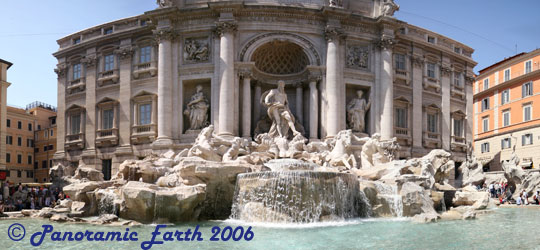
Trevi Fountain (Fontana di Trevi) in Rome

Fontana di Trevi (Trevi Fountain)

This photo of the Trevi Fountain is part of one of the panoramic images found on the PanoramicEarth.com Tour of Rome. There are over 100 images taken from around Rome linked to an interactive map.

The Fontana di Trevi is another one of those places hugely popular with tourists. It is in a small square not far from the Pantheon and in the early morning the surrounding buildings cast a shadow over the fountain. By the time the sun has risen high enough to light the fountain directly, so have the tourists and the square is often packed. The Trevi fountain is also very popular at night, and lit up looks magical.

At almost 30m high and 20m wide, the Fontana di Trevi is the largest and most ambitious Baroque fountain project in Rome. The name comes from it’s position at the junction of three roads (tre vie). The statues on the Trevi Fountain depict marine mythology. Neptune is the central figure, seated on his chariot being guided by two tritons blowing conch shells. Each triton is also leading a sea horse, one of which (right side) is placid while the other on the left is bucking depicting two different conditions of the oceans. In alcoves on either side of Neptune are statues representing Health and Abundance.

Other fountains existed here before the Trevi Fountain. In 1629 Pope Urban VIII decided that the existing one was inadequate and Pietro da Cortona had the idea of including it into the façade of the building. The project was abandoned but then revived in 170 by Pope Clement.

The eventual design is by Nicola Salvi who oversaw the building until excessive time among the mists the project created killed him. A sort of Baroque building accident. It is built at the end of the Aqua Virgo aqueduct, which supplied Rome with water from a fresh source 14 miles outside the city. The destruction of this aqueduct by the besieging Goth hordes contributed to the fall of Rome as the Romans had to fall back on impure waters from the Tiber. The aqueduct was repaired in the 15C.

People stand back to the fountain and throw coins into the Trevi Fountain, which is meant to ensure your return to Rome. It is not illegal to remove them, but the police take a very dim view of this. The coins are removed weekly and are meant to be given to charity. A full panoramic image showing the crowds around the Trevi Fountain is found on the Rome tour by PanoramicEarth.com. An enlargement of this photo can be found on Flickr.

For more articles on Rome see the Rome Index or select one of the labels at the bottom.

Piazza di Spagna - Barcaccia Fountain

Piazza di Spagna

This view of the Barcaccia Fountain in Piazza di Spagna is part of one of the panoramic images found on the PanoramicEarth.com Tour of Rome. There are over 100 images taken from around Rome linked to an interactive map.

The Piazza di Spagna is another place in Rome where people are not in short supply. Like the Pantheon and St. Peter’s it is difficult to find a time when there are not clusters of tourists following guides in and out of the square. The pace of life does not slow down in the night either, especially in the summer when people hang around the square talking and drinking.

The central piece to the square is the Barcaccia (Ugly Boat), a fountain set below ground level shaped from a leaking boat. Designed by either Pietro Bernini or his son, Gian Lorenzo, the fountain is sunk into the ground to compensate for the low water pressure Acqua Vergine. The inspiration for this design may have been a massive flood of the Tiber on Christmas day in 1598 which left a barge stranded in the city.

This image was taken from the base of the Spanish Steps (Scalinata della Trinita dei Monti to call them by their full name) which were built in 1723 to link Piazza di Spagna with the church at the top, the Trinita dei Monti, and the Pincio Hill.

Also in the square is the Keats-Shelley Memorial House where John Keats spent the last 3 months of his life. The square is linked to the Piazza del Popolo by Via del Babuino and surrounded by cafes and restaurants.

A full panoramic image showing the Spanish steps and the rest of the square is found on the Rome tour by PanoramicEarth.com. An enlargement of this photo can be found on Flickr.

For more articles on Rome see the Rome Index or select one of the labels at the bottom.

Monday, October 09, 2006

Piazza Navona - Fountain of Four Rivers

Piazza Navona - Fountain of Four Rivers

This view over the Piazza Navona is part of one of the panoramic images found on the PanoramicEarth.com Tour of Rome. There are over 100 images taken from around Rome linked to an interactive map.

Full 360° panorama of the Piazza Navona

There are a few things that dominate the Piazza Navona of today. The first is the huge Fontana dei Quattro Fiumi in the centre of the long oval square topped with a large obelisk. The other is the shear number of cafés and restaurants that line the piazza. In this sense, the piazza almost feels like the Tardis from Dr.Who as it seems that surely there must be more seating space than the construction of the square could possibly allow for.

Piazza Navona started off life as the Stadium of Domitian, built in 85 AD to hold some 30,000 spectators, and the square still retains the original shape. Most of the streets lead into Piazza Novana where there were gates to the original stadium. Athletes used to enter along Via Agonale, and the area was known as Campus Agonis in the middle ages. From this through ‘in Agonale’ and ‘n’Agona’ the name ‘Navona’ is derived.

Piazza Navona fell into disrepair after the fall of the Roman Empire, decaying into use as a filed and vineyard until the 14C when it became a market place. The current form of the square developed under the orders of pope Innocent X, who also had the Pamphilj Palace built on the square for is family and personal use.

Fontana dei Quattro Fiumi or 'Fountain of the Four Rivers'
This is one of Bernini’s most famous works, along with the Piazza S Pietro in the Vatican. The base of the fountain holds four colossal statues representing four major rivers of the then known world:
Danube for Europe
Ganges for India
Nile for Egypt (with a covered face as the source of the river was not known at the time)
Rio della Plata for America.

Each figure is semi-prostrate before the obelisk places at the centre of the tower. This is meant to symbolize the then sovereignty of the pope over the temporal domains. The obelisk itself was made in Egypt for Demitian and started off it’s Roman career in the Circus of Maxentius on Via Appia, where, after the fall of Rome, it lay for centuries in five pieces before being moved here.

The image here shows two of the statues at the base of the fountain, and the hollow in the massive travertine rocks. In the 17C to 19C the piazza was regularly flooded by stopping up the fountain outlets and the people would play in the water. The full panoramic image shown on the Rome tour by PanoramicEarth.com. For better appreciation of this image go to the collection on Flickr.

For more articles on Rome see the Rome Index or select one of the labels at the bottom.

Piazza della Repubblica

Piazza  de la Republica

This view over the Piazza della Repubblica is part of one of the panoramic images found on the PanoramicEarth.com Tour of Rome. There are over 100 images taken from around Rome linked to an interactive map.

This busy square follows the curve of an exedra of the Diocletian Baths, where the Romas would exercise and play ball games. Because of this it was originally called Piazza Esedra and is often still referred to by this name today. The current piazza took form in the 19C after the reunification of Italy. The colonnades surrounding the square used to be filled with elegant shops, but these have now been replaced by banks, luxury hotels and, next to one, an infamous fast food outlet.

In the middle of the Piazza della Repubblica rests the Fontana delle Naiadi on which recline four naked nymphs representing the spirits of rives and springs. Each nymph is resting on a different creature representing the different forms of water – a sea-horse for the oceans, a water snake for the rivers, a swan for lakes and a frilled lizards for the subterranean streams. The central figure of the sea god Glaucus was added in 1911. In contrast to the modernity of the statues, the water supplying the fountain is fed by the Acqua Marcia, built in 144BC to supply Rome with water from Tivoli.

A large part of the Diocletian Baths have been incorporated into the Basilica of S Maria degli Angeli, which was designed by Michelangelo and adapted later by Vanvitelli. The old wall of the baths in which the entrance to the church is placed are a stark reminder of the prowess of Rome at it’s height.

The full panoramic image shown on the Rome tour by PanoramicEarth.com. For better appreciation of this image go to the collection on Flickr.

For more articles on Rome see the Rome Index or select one of the labels at the bottom.

Friday, September 29, 2006

Rome Articles Index

Below is listed an index of the articles posted about Rome. Each represents a place in Rome that was photographed for the Rome Tour on PanoramicEarth.com, where you will find panoramic images of Rome linked to an interactive map. This list of Roman articles will continue to grow.

St. Peter's Bascilica and the Vatican
St. Peter's Basilica in the Vatican - Facade
St. Peter's Basilica - The Papal Altar
St. Peter's Piazza (Square) in the Vatican
View from Cupola of St. Peter's Basilica over St. Peter's Square

Museums of Rome
Castel Sant Angelo
Galleria Colonna and Palazzo Colonna
Galleria Nazionale d'Art Moderna

Ancient Rome

Arch of Constantine
Arch of Titus
Area Sacra Argentina
Basilica of Julia - Roman Forum
Circus Maximus
Colosseum - Inside
Colosseum - Outside
Column of Marcus Aurelius
Palatine Hill - Stadium
Pantheon
Porta Maggiore and Aqueduct
Pyramid of Gaius Cestius
Roman Forum (Magnum Forum)
Temple of Antonius and Faustina - Roman Forum
Temple of Romulus - Roman Forum
Trajan's Forum

Churches in Rome dedicated to Mary / Maria
S Maria ad Martyres
S Maria delgi Angeli
S Maria della Consolazione
S Maria Maggiore Basilica
S Maria dei Miracoli
S Maria in Monterone
S Maria del Popolo
S Maria in Trastevere
S Maria della Vittoria
SS Nome di Maria al Foro Triano

Other Churches in Rome
Chiesa di Santa Maria in Palmis
Domine Quo Vadis
Il Gesu
S Ambrogio e Carlo
S Bartolomeo all'Isola
S Bernardo alle Terme
S Bonifacio e Alessio
San Carlo alle Quattro Fontane (San Carlino)
S Clemente in Laterano
S Croce in Gerusalemme
S Eugenio
S Giovanni in Laterano
S Lorenzo in Miranda
St Paul within the Walls
S Sussanna

Fountains,
Fountain of Neptune - Piazza Navona
Fontanone dell'Acqua Paola
Fountain of Roma between the Tiber and Anio - Piazza del Popolo
Fontana dei Quattro Fiumi -Piazza Navona
Fontana di Trevi (Trevi Fountain)

Piazzas and OtherSights in Rome

Piazza Colonna
Piazza Navona
Piazza del Popolo
Piazza della Repubblica
Piazza di Spagna and Barcaccia Fountain
Ponte Palatino and Ponte Rotto
Ponte Vittoria Emanuele

This tour is available for other sites to use for free and works as an i-frame with the page code. I have embedded the tour within this blog.

Friday, August 04, 2006

Shooting Rome

Font di Trevi - RomeRome, city of around 1000 churches. It not just feels like that when walking around, this is a fact. On almost every corner you will stumble upon another one, often heavily decorated inside. The trip to update and expand the Rome content for Panoramic Earth was completed a short while ago. We have managed to cover all the famous sites again and add a huge collection of other places. Quite a few of them are, yes, churches.

But if you want to have a wonder around the Colesseum, St.Peters, see the Font di Trevi or the Pantheon, then these will shortly be added to the Rome tour. It just takes a little while to put together over 100 panoramic photographs and then add them to the map. So please be a little more patient with us, it is coming, but we still have to eat and sleep in between times staring at a computer screen.

Some of the observations I had while there – Rome is mostly cobbled roads. These have potholes in them and are uneven to say the least. Spending 6+ hours a day on a bike cycling round the city to collect the photographs does not make you friends with your butt. Neither does working non stop for all that time in temperatures often exceeding 35º! Rome also lacks from imagination when it comes to squares, there is nothing planted out in the plazas, just expanses of black cobbles.

That aside it does have the Pantheon, Colessuem, forum, St.Peters and hundreds of other fantastic buildings. And the evenings can make up for it, the food is fantastic, and walking around the centre late at night can be quite relaxing.

New Panoramas on Panoramic Earth