Showing posts with label peter. Show all posts

Friday, September 29, 2006

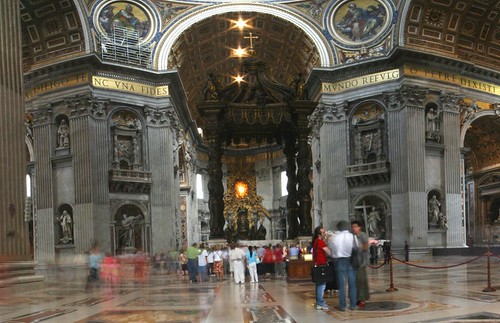
St Peter's Basilica Rome - The Papal Altar

This image of the Papal Alter in St. Peter's Basilica in Rome ispart of one of the panoramic images found on the PanoramicEarth.com Tour of Rome. There are over 100 images taken from around Rome linked to an interactive map.

Full 360° panorama of the Basilica of Saint Peter

The Basilica of Saint Peter is officially known in Italian as the Basilica di San Pietro in Vaticano and colloquially called Saint Peter's Basilica. It is the focal point of the Vatican. St Peter’s Basilica has been through many changes over the centuries. The first St. Peter’s was built by Constantine between 320-322 AD. Over the following centuries the site endured several lootings and further embellishments. By the 1500 St. Peter’s had suffered from neglect, was irreparable and dismantled to make room for the current Basilica. Thus on April 18, 1506, the cornerstone to the current version of St. Peter’s Basilica was laid by Pope Julius II. Work continued for over 100 years to produce the current form.

Extensive information about the Basilica can be found on stpetersbasilica.org. The interior of St. Peter’s Basilica is a museum in it’s own right. There are over 400 statues on display aside from other paintings and artifacts. In addition to this the Basilica is large enough to house over 40 chapels. Entrance is via one of 5 named doors of the portico, each of which has a distinct history. The central door is from the old St. Peter’s Basilica. St. Peter’s Basilica is laid out in the form of a Latin Cross, the main nave is 40m high and the floor laid in intricate marble patterns.

The central focus is the Papal Altar, where only the pope celebrates Mass. The baldachin rising over the central altar was designed by Bernini. It is made of 37 tonnes of bronze, stands some 30 meters high, built to fill the space beneath the dome soaring about 140m above it. The bronze used was taken from the Pantheon. Underneath this baldachin is the traditional tomb of St. Peter.

Surrounding the 4 corners of this canopy are 4 pillars which support the weight of the dome. Each of these is 71m in circumference. Each contains a huge statue 4 saints whose relics are preserved in chapels set above the statues part way up the columns. These are the saints Helena, Veronica, Andrew and Longinus (who is said to be the soldier who pierced Jesus whilst he hung on the cross). At the tops of the columns a Latin inscription runs around the base of the arches. Above this are 4 mosaics.

As can be seen in this picture, the whole environment dwarfs those attending it. There are more panoramas from Rome on Panoramic Earth. There is an enlargement of this image of St. Peter's on Flickr.

For more articles on Rome see the Rome Index or select one of the labels at the bottom.

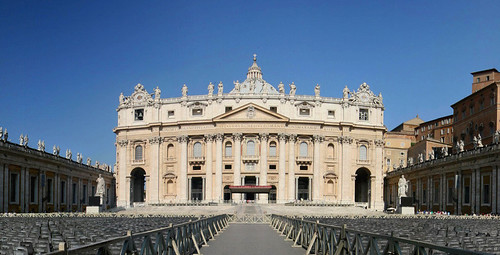
St. Peters Basilica - Rome. The Facade

This image of the front of St. Peter's Basilica in Rome ispart of one of the panoramic images found on the PanoramicEarth.com Tour of Rome. There are over 100 images taken from around Rome linked to an interactive map.

Full 360° panorama of the view from the front of St. Peter's Bascilica.

The Basilica of Saint Peter is officially known in Italian as the Basilica di San Pietro in Vaticano and colloquially called Saint Peter's Basilica. It is the focal point of the Vatican. St Peter’s Basilica has been through many changes over the centuries. Just over 500 years ago, on April 18, 1506, the cornerstone to the current version of St. Peter’s Basilica was laid by Pope Julius II. At the beginning of the first Century AD the area was the gardens of Agrippina. Caius Caligula built a circus here and the obelisk in the centre of St. Peter’s Square was erected near to it’s current position at this time.

Work on the current façade of St.Peter’s began on February 10, 1608, taking until 1612 to complete. The ornamentation took another 2 years to install. The 1m high inscription that runs above the main columns states: "Paul V Borghese, Roman, Pontiff, in the year 1612, the seventh of his pontificate, [erected] in honour of the Prince of Apostles". The central balcony, the Loggia of the Blessings, is the site from which a new pope is announced, and from where the pope gives the Urbi et Orbi blessing. The façade of St. Peter’s is 118m wide and 48m tall.

The front of St. Peter’s is hugely impressive, people seem dwarfed by the façade. Along the top are 13 massive travertine statues of Christ, other gospel characters. These are, from left to right – Thaddeus, Matthew (gospel writer), Philip, Thomas, James, John the Baptist, Jesus Christ (central figure with a cross), Andrew, John the Evangelist (gospel writer), James the younger, Bartholomew, Simon and Matthias. Peter is represented in a relief under the Loggia of the Blessings with Christ.

Currently visitors to St. Peter’s Basilica ascend a series of steps from the far right of the façade having passed through security and walking past a huge 5.5m tall statue of St. Paul placed upon a pedestal almost 5m high. Entrance to the Basilica itself is through the main doors in the centre of the façade. Those wishing to visit the tombs of the popes or ascend to the Capula of Ct. Peter’s must pass to the right of the façade. Those leaving the tour of the tombs pass out along the left of the façade where the Swiss Guards are stationed at the Arch of Bells Entrance. Above this arch are the bells of St. Peter’s, the larges of which is 2.5m in diameter.

There is an enlargement of this picture of the facade of St. Peter's Basilica on Flickr. Panoramic Earth also has panoramas from St. Peter's Square and inside St. Peter's Basilica with more information.

A very good map of the area with further information is found on St.PetersBasilica.org Square and Area pages.

For more articles on Rome see the Rome Index or select one of the labels at the bottom.

Thursday, September 28, 2006

Saint Peter's Piazza - Rome


Piazza S Pietro

St. Peter's Square in Rome is one of the panoramic images found on the PanoramicEarth.com Tour of Rome. There are over 100 images taken from around Rome linked to an interactive map.

Full 360° panorama of Saint Peter's Square (Piazza San Pietro)

Saint Peter's Square (Piazza San Pietro) is also known as Saint Peter's Piazza. It is the open space directly in front of St. Peter’s Basilica in the Vatican City. It is here that a congregation gathers every Wednesday morning to hear a Papal address, and also to see the Pope from the balcony of the Papal residence to the right of the piazza. The dimensions of St. Peter’s Square are almost identical to those of the inside of the Colosseum. It is estimated that 300,000 people could easily gather here without crowding.

Design of St. Peter's Square:
St. Peter’s Square was redesigned by Gian Lorenzo Bernini under the rule of Pope Alexander VI between 1656 to 1667. The piazza is partially surrounded by two curved, covered colonnades, each of which contains 4 rows of a total of 284 Doric style columns. On top of each colonnade are statues of 96 saints and martyrs. At the centre of the Piazza is a 25.5m tall red granite obelisk which dates from the 13th Century BC. It had originally been brought to Rome from Egypt in 35 AD by Emperor Caligula and was moved to the current site in 1586 by the engineer Domenico Fontana under the direction of Pope Sixtus V. The task took 900 men, 150 horses and 47 purpose-built cranes to complete. On the top of the obelisk was a guilt ball that was thought to contain the ashes of Julius Caesar. This was removed a replaced with an iron cross.

At the focal point of each of the colonnades are spectacular 2 fountains which were placed here in 1614 and 1667. Between the obelisk and each fountain is a small round porphyry slab. Viewing the colonnades from these positions gives you the illusion that there is only one row of columns. The paving of the square is broken up by lines of travertine radiating from the centre. Around the obelisk are the markings of a compass. In 1817 circular stones were set to mark the tip of the obelisk at noon as the sun entered each of the signs of the zodiac, making of the obelisk a gigantic sundial's gnomon.

From the far end of the Piazza three flights of steps ascend to the entrance of St Peter’s Basilica, the focal point of the temporal jurisdiction of the Roman Catholic Church.

There are more panoramas from the Vatican on Panoramic Earth. The larger version of this image is available on Flickr.

For more articles on Rome see the Rome Index or select one of the labels at the bottom.
New Panoramas on Panoramic Earth