Showing posts with label gallery. Show all posts

Friday, December 08, 2006

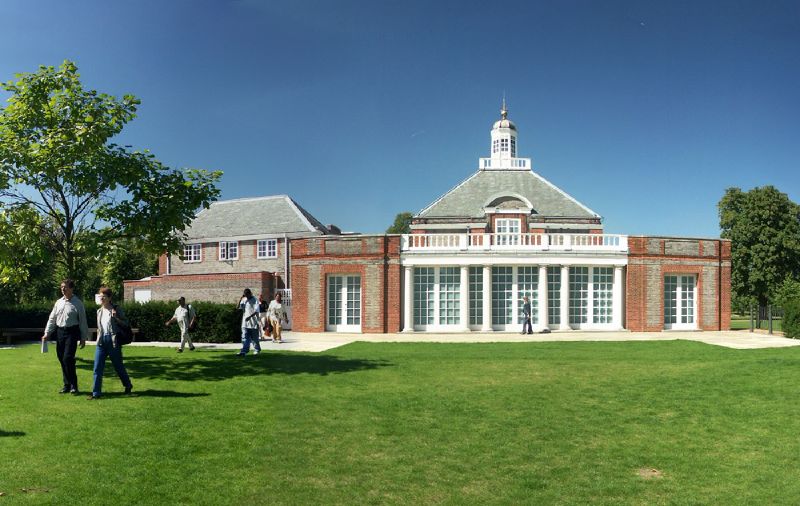
Serpentine Gallery in Kensington Gardens

Serpentine Gallery in Kensington Gardens

This photo of the view of the Serpentine Gallery in Kensington Gardens, London is part of one of the panoramic images found on the PanoramicEarth.com Tour of London. There are over 100 images taken from around London linked to an interactive map.

Plan your visit to London by taking advantage of these London Hotel Specials or Thomson City Breaks. Get the most of London with these London Guide Books

The Serpentine Gallery is surrounded by Kensington Gardens and Hyde Park, just a short distance form the Serpentine. It looks nothing like a traditional gallery, being housed in a Grade II listed former tea pavilion that was built in 1934. In 1998 the Serpentine Gallery was refurbished with a £4 million grant.

The grounds at the entrance to the Serpentine Gallery house a permanent work dedicated to Princess Diana, former patron of the Serpentine Gallery. This piece was made by Ian Hamilton Finlay and Peter Coates.

In contrast to the classical surroundings, many of the exhibitions at the Serpentine Gallery feature modern artists, and the list of those who have exhibited here is long and prestigious, including Henry Moore, Bridget Riley, Andy Warhol, Man Ray, Damien Hirst and Rachel Whiteread to name a few.

Unlike many other galleries in London, the special temporary exhibitions at the Serpentine Gallery remains free for all to visit. The gallery used to only be open during the summer months, but this may now have changed. Check the Serpentine Gallery website for current exhibition information and opening times.

Given the patronage of the late Princess Diana of the Serpentine Gallery, it is fitting that the Diana Memorial Fountain is just across the road from the gallery near to the Serpentine lake. Also near to the Serpentine Gallery are the Albert Memorial and the Royal Albert Hall, while Hyde Park Corner, and the Wellington Arch, are just a few minutes away.

Over 200 Destinations with HotelConnect.

The nearest tube station is Hyde Park Corner, while South Kensington is about 10 minutes away down Exhibition Road and past the V&A and Science Museums.

The full panoramic image taken from the junction of the Serpentine Gallery can be found on the London tour by PanoramicEarth.com. An enlargement of this photo can be found on Flickr. You can also find a marker for Parliament Square on Tagzania.

For more articles on London see the London Index or select one of the labels at the bottom.

Monday, November 13, 2006

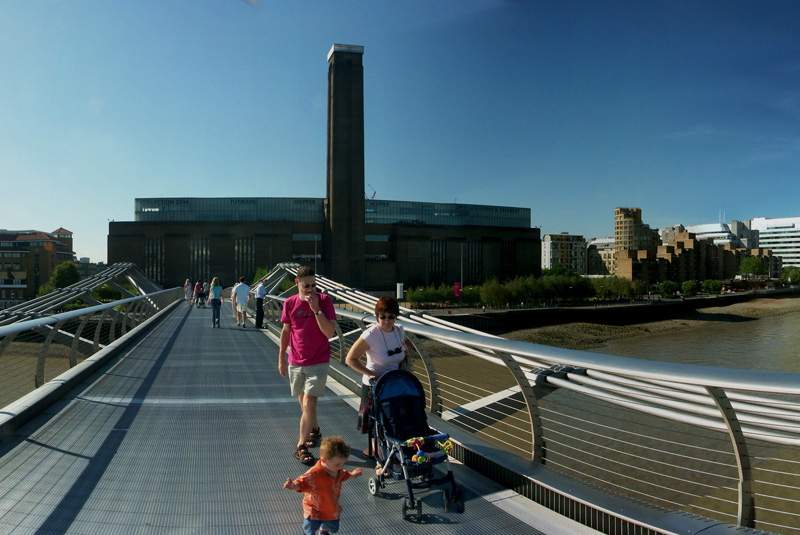
Tate Modern - London

 Tate Modern from seen from the middle of Millennium Bridge

This photo of The Tate Modern in London is part of one of the panoramic images found on the PanoramicEarth.com Tour of London. There are over 100 images taken from around London linked to an interactive map.

Plan your visit to London by taking advantage of these London Hotel Specials or Thomson City Breaks. Get the most of London with these London Guide Books

The Tate Modern is the latest addition to The Tate group of galleries located within Britain and also online. The Tate Modern, opened in May of 2000, is the national museum of international modern art, and therefore modern both in terms of the use of the building and the collection it contains. Situated on the Thames and linked St. Paul’s Cathedral via the Millennium Bridge, the Tate Modern has quickly won favour both with Londoners and visitors to London.

From the very outset as you approach the Tate Modern, especially across the Millennium Bridge, it is clear that this building was not originally designed as an art gallery or museum. The 200m long building is almost featureless except for a 90m high chimney stack placed half way along. In a former life this was the Bankside Power Station, built in 1947 and closed in 1981 when the price of oil made it too uneconomical to run. Eventually after nearly 20 years of dereliction a new use for the building was secured and the Tate Modern was born. The conversion started in 1995, taking 5 years and £134 million to complete.

One of the most striking features of the Tate Modern is the huge Turbine Hall, which at 152m long and 35m high makes it one of the largest spaces in which to display art in the world. Parallel to this space ran the boiler house which has now been converted to hold the galleries or ‘suites’ as the Tate Modern like to call them. There are 2 floors with permanent exhibits, while temporary works are displayed on the third floor. Above these the Tate houses a café-restaurant with truly stunning views over the rest of London. The top of the Tate Modern’s chimney is capped with a luminous roof called the Swiss Light and sponsored by the government of Switzerland. At night time this light makes the Tate Modern clearly visible for many miles.

The Turbine Hall has seen some fantastic large sculptures since 2000, Almost always these installations have caused lively debate and attracted huge numbers of visitors, form the Unilever Series by Rachel Whitehead (nick named the Tate sugar cubes) to the current slides created by Carsten Höller. If anyone said the modern art could not be fun, then surely a visit to the Tate Modern at the moment would address that, though the question of ‘Is it art?’ may not be easy to answer.

The opening of the Tate Modern has helped to revitalize the South Bank. It is linked to the Tate Britain by a distinctive river ferry decorated in bright coloured spots. The Tate Modern is also close to quite a number of other attractions in the area including St. Paul’s Cathedral and the Oxo Tower. Situated about half way between the London Eye and the Tower of London (and Tower Bridge) the Tate Modern is well worth including in any London itinerary.

Over 200 Destinations with HotelConnect.

The full panoramic image taken of the Tate Modern in London can be found on the London tour by PanoramicEarth.com. An enlargement of this photo can be found on Flickr.

For more articles on London see the London Index or select one of the labels at the bottom.

Wednesday, October 25, 2006

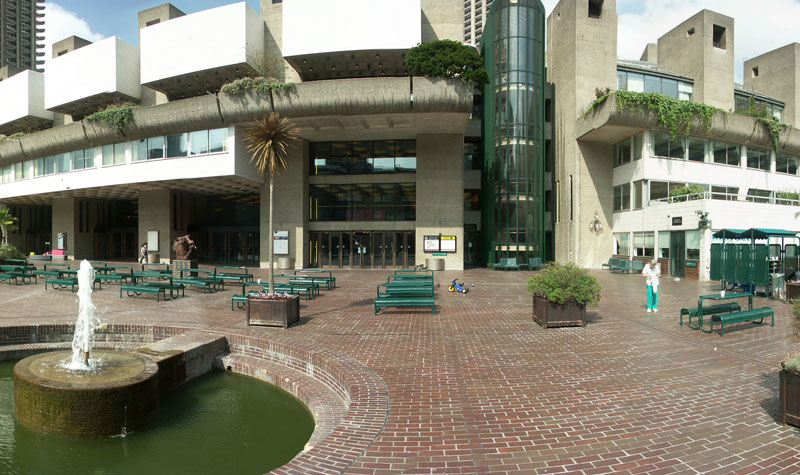
Barbican Centre - London

Outside of the Barbican Center in the City of London

This photo of the Barbican Arts Centre in London is part of one of the panoramic images found on the PanoramicEarth.com Tour of London. There are over 100 images taken from around London linked to an interactive map.

Plan your visit to London by taking advatage of these London Hotel Specials or Thomson City Breaks.

“The Barbican is Europe's largest multi-arts and conference venue presenting a year-round programme of art, music, film and theatre.” – So says the blurb on the Barbican Website.

And this may well be true for under one roof here you can find a concert hall, two theatres, three cinemas, two art galleries, conservatory and public library, three restaurants, private function rooms, conference suites, two exhibition halls and the Guildhall School of Music & Drama. It is open 363 days a year and offers a vast array of visual and performing arts. It would almost be quicker to list the types of material that is not shown at the Barbican Centre than to list what is.

In spite or all this glory, the Barbican Centre has also the dubious honour of being voted "London's ugliest building" in a poll run by the BBC in September 2003. This is compounded by an exceedingly complex and confusing layout both inside and out, which, while revolutionary at the time, has evermore left visitors often perplexed as to how to get around. Outside are some lovely terraces with fountains.

The area in which the Barbican Centre now sits was heavily bombed in WWII, yet it took quite some time for the redevelopment to happen. It was opened in 1982, being mostly funded by the City of London as a gift to the nation to the tune of £161 million (about £450 million today).

The Barbican is the home of the London Symphony Orchestra and was, until recently, the home of the Royal Shakespeare Company. The nearst tube is the Barbican, and the Museum of London and St. Paul's Cathedral are also nearby.

Over 200 Destinations with HotelConnect

The full panoramic image showing the outside of the Barbican Centre and the fountain terraces
can be found on the London tour by PanoramicEarth.com. An enlargement of this photo can be found on Flickr.

For more articles on London see the London Index or select one of the labels at the bottom.

Tuesday, October 10, 2006

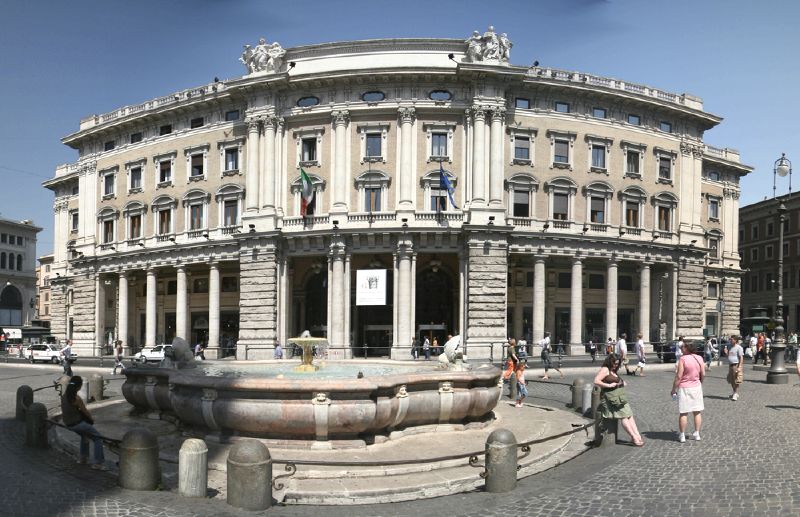
Palazzo Colonna and Galeria Colonna

Palazzo Colonna, location of the Galleria Colonna

This photo of the front of the Palazzo Colonna is part of one of the panoramic images found on the PanoramicEarth.com Tour of Rome. There are over 100 images taken from around Rome linked to an interactive map.

The Galleria Colonna is contained within the Palazzo Colonna, a palace that has been in the Colonna family for over 20 generations. This rise to glory started in the Middle Ages when the Colonna family was the most powerful feudal force in Rome. In 1424 the family managed to elect their own pope, which resulted in huge benefits and triggered the building of a huge new family compound, the Palazzo Colonna.

In the 1700s the building was rebuilt and the family had moved on from nominating popes to collecting art. Consequently there is now quite a collection of late Renaissance and Baroque paintings stored and displayed here. Six of the rooms are open to the public, and though the paintings are not labeled a key to them is available.

The first room contains a number of family portraits and the Temptation of St. Anthony. After thisis the Great Hall with a gilded ceiling and a painting of Mary about the clobber the Devil who is trying to steal a baby. The third room, Hall of the Desks, is named after two superb ancient desks contained in it. The fourth room features Martin V, the Colonna member to become pope, and the fithe Throne Room contains a chair turned to the wall for use by the pope should he choose to drop by. The last room is named after Maria Mancini, nice of Cardinal Mazarin who ran France for much of the late 1600’s.

From the Gallery you can also see into the private garden and the rouns of the Temple of Cerapis with 20m high marble columns. This area is not open to the public.

In the Piazzo Colonna on which the Palazzo Colonna is built, stands the 30m high Column of Marcus Aurelius, built in the time of Emperor Aurelius. Made of about 27 hollow 3.7m wide blocks the hollow column contains a spiral staircase leading to the top. The Intricate relief depicts the Danubian or Marcomannic wars of Marcus Aurelius, waged by him from 166 to his death.

A full panoramic image showing the square around Palazzo Colonna is found on the Rome tour by PanoramicEarth.com. An enlargement of this photo can be found on Flickr.

For more articles on Rome see the Rome Index or select one of the labels at the bottom.

New Panoramas on Panoramic Earth